
Why Honey Makes the Best Fried Chicken Glaze
This guide keeps two methods separate. The measured card makes boneless chicken tenders with a thin buttermilk coating and a fixed amount of pan oil. The traditional brined, double-dredged deep-fry method follows below.
The card estimate counts every weighed ingredient, including all pan oil and coating input; it does not claim a measured absorbed-oil amount. It does not apply to the deep-fried version, whose brine, loose dredge and frying oil are partly discarded.
Recipe
Measured Pan-Fried Honey Chicken Tenders
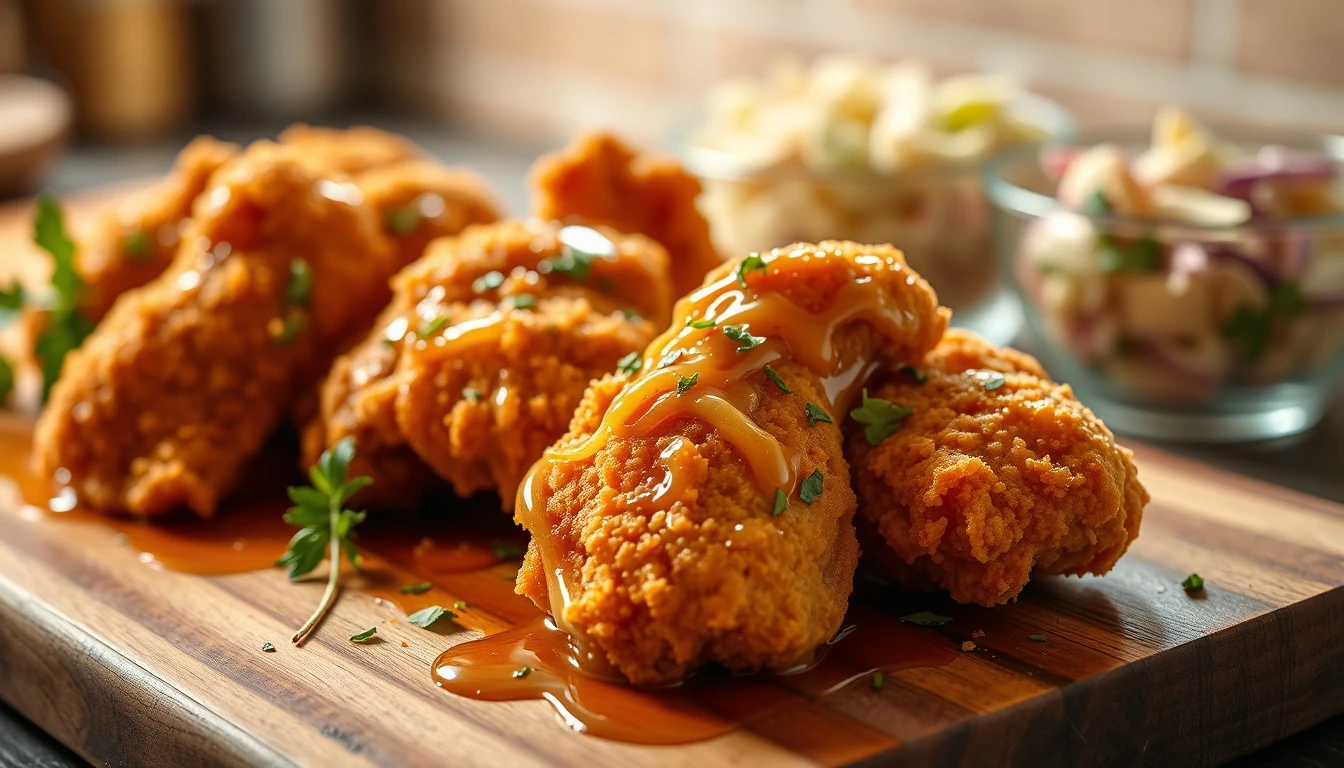
Crisp honey-glazed pan-fried chicken tenders, plus traditional buttermilk-brined deep-fry instructions and five honey sauce variations.
13Ingredients
Yield: 4 servings
- 680 g boneless skinless chicken breast, cut into tenders
- 120 g cultured lowfat buttermilk
- 100 g all-purpose flour
- 32 g cornstarch
- 1 teaspoon garlic powder
- 1 teaspoon paprika
- 1/2 teaspoon onion powder
- 1 teaspoon table salt, divided
- 1/2 teaspoon ground black pepper
- 54 g canola oil
- 1/3 cup clover honey
- 2 tablespoons unsalted butter
- 1 tablespoon apple cider vinegar
Ingredient amounts scale; instructions show the original batch. Cooking times and pan sizes may need adjustment. Season to taste. Honey grams use US measures at 20°C and 17.5% moisture, a density estimate; weigh your honey for precision.
Instructions
- 1Prepare the tendersPat the boneless chicken strips dry and make them a similar thickness. Mix flour, cornstarch, garlic powder, paprika, onion powder, pepper and half the salt.
- 2Make a measured coatingStir the buttermilk into the dry mixture to make a thick coating. Turn the chicken in it, spreading the measured mixture across the strips rather than setting out an unmeasured bowl of dredge. Rest about 10 minutes while preparing the pan and glaze.
- 3Pan-fry in batchesHeat half the canola oil in a wide heavy skillet over medium heat. Cook half the tenders, turning once, until browned and the center reaches 165°F (74°C). Repeat with the remaining oil and tenders. Timing varies with thickness; lower the heat if the coating browns too fast.
- 4Make the glazeGently melt butter and stir in honey, cider vinegar and the remaining salt. Warm just until combined.
- 5Finish and serveCoat the cooked tenders with all the glaze and divide into 4 portions. The input estimate includes all weighed pan oil even if some remains behind; it is not a measured absorption result.
Estimated nutrition per serving
600.32 calories · 24.37 g fat · 52.43 g carbohydrate · 42.25 g protein · 707.35 mg sodium
Serving: 1 of 4 tender portions; input estimate includes all measured oil
Calculated from ingredient weights and USDA FoodData Central: 171077, 170874, 168894, 169698, 171325, 171329, 171327, 173468, 170931, 172336, 169640, 173430, 173469. Estimates use ingredient input weights; actual portions, brands and cooking losses vary. Omitted nutrient values are unavailable, not zero.
Measured Base and Preparation Notes
Use the measured card for the stated base estimate. Other methods and additions below are separate variations.
- The card is a pan-fried tender base. The brined deep-fry method below is retained as a separate preparation, not silently assigned the same nutrition.
- Keep the chicken thickness even and confirm 165°F (74°C) in the center. A browned coating alone does not establish doneness.
- Do not pour a pot of deep-frying oil into the input estimate or assume a percentage was absorbed.
Get the Honey Buyer's Cheat Sheet (free PDF)
16 varieties on one page — color, flavor, best use and what a fair price looks like — from the 304 honeys we track.
Traditional Buttermilk-Brined Deep-Fry Method
This retained method uses a larger bone-in or tender batch, a refrigerated brine, loose double dredge and a pot of frying oil. It is not the measured pan-fried card and has no invented oil-absorption or brine-retention estimate.
- For 3–4 lb chicken pieces, mix 2 cups buttermilk with 2 tablespoons honey, 1 tablespoon salt, 1 teaspoon each garlic powder and paprika, and 1/2 teaspoon cayenne. Cover the chicken in this mixture and refrigerate for at least 4 hours or overnight.
- Mix 2 cups flour, 1/2 cup cornstarch, 1 tablespoon each garlic powder and paprika, 1 teaspoon each onion powder, salt and black pepper, and 1/2 teaspoon cayenne.
- Lift chicken from the brine, dredge in the flour mixture, dip back into brine, then dredge again. Rest on a rack for 10 minutes. Discard brine and dredge that contacted raw chicken.
- Heat a pot of suitable frying oil to 325°F (165°C) without overfilling it. Fry small batches, turning as needed, until the center reaches 165°F (74°C). Piece size changes the time; keep a thermometer in control rather than promising one duration for thighs, drumsticks and tenders.
- Use the card’s honey glaze or one of the sauce variations, dividing a measured glaze batch across the finished chicken. The deep-fried chicken itself is outside that card estimate.
5 Honey Fried Chicken Sauce Variations
Each variation modifies the base honey glaze. Melt butter first, then add the remaining ingredients.
- 1. Nashville hot honey — Add 2 tablespoons cayenne pepper, 1 tablespoon brown sugar, 1 teaspoon smoked paprika, and 1/2 teaspoon garlic powder to the base glaze. Brush generously over the chicken. The combination of honey sweetness and serious heat is the signature Nashville hot chicken profile.
- 2. Honey garlic — Add 4 minced garlic cloves to the melting butter, cook for 30 seconds until fragrant, then add honey, 2 tablespoons soy sauce, and 1 teaspoon sesame oil. The honey garlic combination creates an umami-rich glaze that works on any cut.
- 3. Lemon herb honey — Add 2 tablespoons fresh lemon juice, 1 teaspoon lemon zest, 1 tablespoon chopped fresh thyme, and 1 tablespoon chopped fresh rosemary to the base glaze. Bright, herbaceous, and particularly good on chicken tenders.
- 4. Honey BBQ — Mix the honey glaze with 3 tablespoons of your favorite honey BBQ sauce. Quick and easy with layered smoky-sweet flavor. Or make a from-scratch version: add 2 tablespoons tomato paste, 1 tablespoon smoked paprika, and 1 teaspoon Worcestershire to the base glaze.
- 5. Honey mustard — Whisk 3 tablespoons Dijon mustard and 1 tablespoon whole-grain mustard into the warm base glaze. The tangy mustard cuts through the richness of the fried chicken. Serve extra on the side for dipping. See also: honey mustard sauce.
Honey Pairing Guide
Compare clover honey, wildflower honey and the best honey for cooking guide. The flavor-intensity scale is editorial, not a laboratory measurement.
1 = mild, 5 = bold. Editorial pairing guidance, not laboratory measurements; jars vary.
- Clover
- Mild base sweetness
- Wildflower
- Floral finish
- Orange blossom
- Citrus-floral variation
Matching a honey to another dish: the honey flavor map
Serving and Storage
Serve the finished dish promptly. Refrigerate perishable leftovers in covered containers and reheat until hot; crisp coatings soften during storage.
Sides, dips, extra garnishes and the optional variations are outside the measured base estimate.
Nutrition Estimate
USDA input edible weights divided by yield; no cooking-loss or discarded-food adjustment assumed.
The estimate uses the recorded USDA ingredient references and divides the input into the stated servings. It is not a laboratory analysis or a measured cooking-yield result. Unknown nutrients are omitted rather than replaced with zero.


