Why Honey Garlic Wings Are Worth Making at Home
Bake the wings first and coat them just before serving. A long bake with the honey already on the skin can darken the glaze before the meat is done; keeping the sauce separate gives you more control.
The measured batch starts with 3 pounds of whole raw wings, including the tips, for four main-dish portions. Keep the tips attached during baking. A bag of trimmed drumettes and flats is a different purchase weight and cannot use the same bone allowance. Clover honey makes a mild sauce; wildflower honey is more floral.
Recipe
Crispy Honey Garlic Wings
Bake bone-in chicken wings, then coat them with honey garlic glaze. Includes five sauce variations, a 165°F poultry endpoint and clear timing.
13Ingredients
Yield: 4 servings
- 3 lb raw whole chicken wings including tips
- 12 g baking powder
- 6 g fine salt
- 1.15 g ground black pepper
- 1.55 g garlic powder
- 112 g honey
- 48 g soy sauce
- 15 g garlic, minced
- 15 g cider vinegar
- 4.5 g sesame oil
- 14.2 g unsalted butter
- 8 g cornstarch
- 30 g cold water
Ingredient amounts scale; instructions show the original batch. Cooking times and pan sizes may need adjustment. Season to taste. Honey grams use US measures at 20°C and 17.5% moisture, a density estimate; weigh your honey for precision.
Instructions
- 1Dry and coat the whole wingsHeat the oven to 425°F (220°C). Use 3 pounds of whole raw chicken wings with the tips still attached. Pat dry, then toss with the baking powder, salt, pepper and garlic powder. Arrange on an oven-safe rack over a rimmed sheet pan with space between pieces. Do not substitute 3 pounds of pre-trimmed pieces in the published estimate.
- 2Bake to the poultry endpointBake for about 45–50 minutes, turning once around the middle of cooking. Check several of the thickest pieces with a thermometer, avoiding bone: they must reach at least 165°F (74°C). Continue cooking if they have not reached that temperature.
- 3Cook the honey garlic sauceNear the end of the bake, melt the butter in a skillet over medium-low heat. Add the minced garlic and stir for about 30 seconds without browning it. Add the honey, soy sauce, cider vinegar and sesame oil and bring to a gentle simmer.
- 4Thicken the glazeMix the cornstarch and cold water until smooth. Stir into the simmering sauce and cook for 1–2 minutes until it thickens. If it becomes too thick to coat the wings, loosen it with a small splash of water.
- 5Coat just before servingToss the cooked whole wings with the hot glaze and divide into four portions. You may separate the joints for serving after cooking. Extra seeds, sliced onions and dipping sauces are outside the base recipe. The ingredient estimate excludes raw bone and connective tissue but makes no claim about how much fat remains on the baking tray.
Estimated nutrition per serving
547.33 calories · 31.1 g fat · 28.06 g carbohydrate · 38.34 g protein · 1739.08 mg sodium
Serving: 1 of 4 servings
Calculated from ingredient weights and USDA FoodData Central: 172390, 172803, 173468, 170931, 171325, 169640, 174277, 169230, 173469, 171016, 173430, 169698, 173647. Estimates use ingredient input weights; actual portions, brands and cooking losses vary. Omitted nutrient values are unavailable, not zero.
Choose the honey by flavor
Our best honey for cooking guide compares mild jars with darker, stronger-flavored varieties. The map below is an editorial 1–5 intensity scale, not a measured nutrition or sweetness result.
1 = mild, 5 = bold. Editorial pairing guidance, not laboratory measurements; jars vary.
- Clover
- Garlic and a mild savory glaze
- Wildflower
- Herbs and roast meat
- Buckwheat
- Smoky or spiced variations
Matching a honey to another dish: the honey flavor map
Get the Honey Buyer's Cheat Sheet (free PDF)
16 varieties on one page — color, flavor, best use and what a fair price looks like — from the 304 honeys we track.
Choosing the Best Honey for Wings
- Wildflower honey — Our top pick. Multi-floral complexity produces the most interesting, layered glaze. Medium sweetness balances the garlic and soy perfectly.
- Clover honey — Clean, neutral sweetness that lets garlic and soy flavors dominate. The most crowd-pleasing, familiar option.
- Buckwheat honey — Bold, molasses-like depth that creates a darker, richer glaze with almost BBQ-like undertones. Outstanding for the smoky variation.
- Orange blossom honey — Subtle citrus brightness that lifts the glaze and pairs beautifully with the ginger variation.
- Sourwood honey — Buttery caramel notes with slight tang that add sophistication. A premium choice for special occasions.
5 Glaze Variations
Each variation modifies the glaze while keeping the same crispy baked wing base. Mix and match for a wing platter with multiple flavors.
- Honey Garlic Buffalo: Add 3-4 tablespoons hot sauce (Frank's RedHot) to the base glaze for sweet-heat wings that combine the best of honey's sweetness with classic buffalo punch. Serve with blue cheese and celery.
- Sticky Sesame Ginger: Add 1 tablespoon grated fresh ginger, 1 extra teaspoon sesame oil, and 1 tablespoon toasted sesame seeds to the glaze. Lighter and more aromatic, inspired by honey and ginger pairings.
- Smoky Honey BBQ: Add 2 tablespoons tomato paste, 1 teaspoon smoked paprika, and 1/2 teaspoon cumin. Use buckwheat honey for maximum depth. Serve with honey cornbread and coleslaw.
- Korean-Inspired Gochujang: Replace soy sauce with 2 tablespoons gochujang + 1 tablespoon soy sauce. Add 1 teaspoon toasted sesame seeds. The fermented chili paste adds complex umami heat that pairs brilliantly with honey's sweetness.
- Lemon Pepper Honey Garlic: Add the zest and juice of 1 lemon plus 1 teaspoon coarsely cracked black pepper to the base glaze. Bright, peppery, and addictive — the citrus cuts through the richness.
Tips for the Crispiest Wings
The difference between good and great honey garlic wings comes down to texture. Drying and spacing the wings helps the skin brown.
- Dry the wings thoroughly. Surface moisture is the enemy of crispiness. Pat each wing dry with paper towels before seasoning. For extra crispiness, place seasoned wings uncovered on the wire rack in the refrigerator for 1-4 hours before baking.
- Use a wire rack. Placing wings directly on a sheet pan traps steam underneath, creating a soggy bottom. The wire rack allows hot air to circulate around every surface.
- Don't overcrowd. Wings need space between them for air circulation. If they touch, they steam instead of roast. Use two sheet pans if necessary.
- Flip once. Flipping at the halfway point ensures even browning on both sides without disturbing the crisping process too frequently.
- Toss in glaze at the last minute. The glaze will soften the skin over time. Toss right before serving and eat within 15-20 minutes for peak crispiness.
Serving Ideas
Honey garlic wings work as the star of game day spreads, weeknight dinners, Father's Day cookouts, or party appetizers.
- Classic game day platter: Serve with celery, carrot sticks, blue cheese dip, and ranch. Add honey mustard as an alternative dipping sauce.
- Over rice: Drizzle extra glaze over steamed jasmine rice and top with wings for a complete meal.
- Wing bowl: Serve over a bed of shredded cabbage, pickled vegetables, and rice with extra glaze as a dressing.
- Lettuce wraps: Remove meat from bones and serve in butter lettuce cups with pickled onion, cucumber, and a squeeze of lime.
- Party appetizer: Arrange on a platter with toothpicks, dipping sauces, and napkins. Double the recipe for crowds of 10+.
- Meal prep: Wings reheat well. Store in the fridge for 3-4 days and reheat in a 375°F oven for 10 minutes to re-crisp the skin.
Common Mistakes and Fixes
- Wings aren't crispy: Almost always caused by not drying the wings thoroughly or skipping the baking powder. Pat them dry twice and make sure baking powder coats every piece evenly.
- Skin is burnt but meat is raw inside: Oven temperature too high or wings are too large. Use an instant-read thermometer — internal temperature should reach 165°F (74°C). If skin browns too fast, tent loosely with foil.
- Glaze slides off: The glaze needs to be thick enough to cling. If it's too thin, simmer it another 2-3 minutes or add a second cornstarch slurry (1 teaspoon cornstarch + 1 tablespoon water).
- Garlic burns in the sauce: Garlic goes from golden to bitter in seconds. Keep heat at medium, stir constantly, and add the liquid ingredients quickly after the garlic becomes fragrant.
- Wings taste like baking soda: You used baking soda instead of baking powder. They are different products. Use aluminum-free baking powder only.
Serving the finished dish
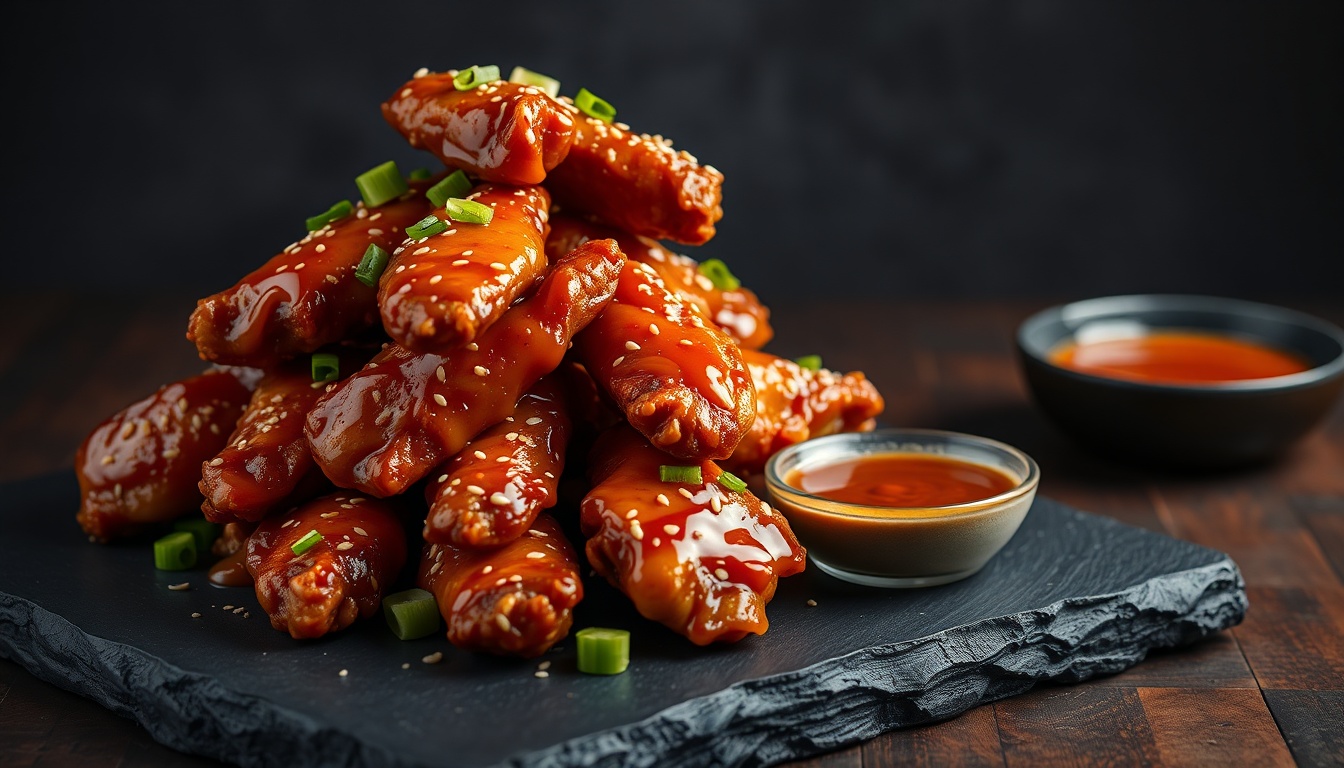
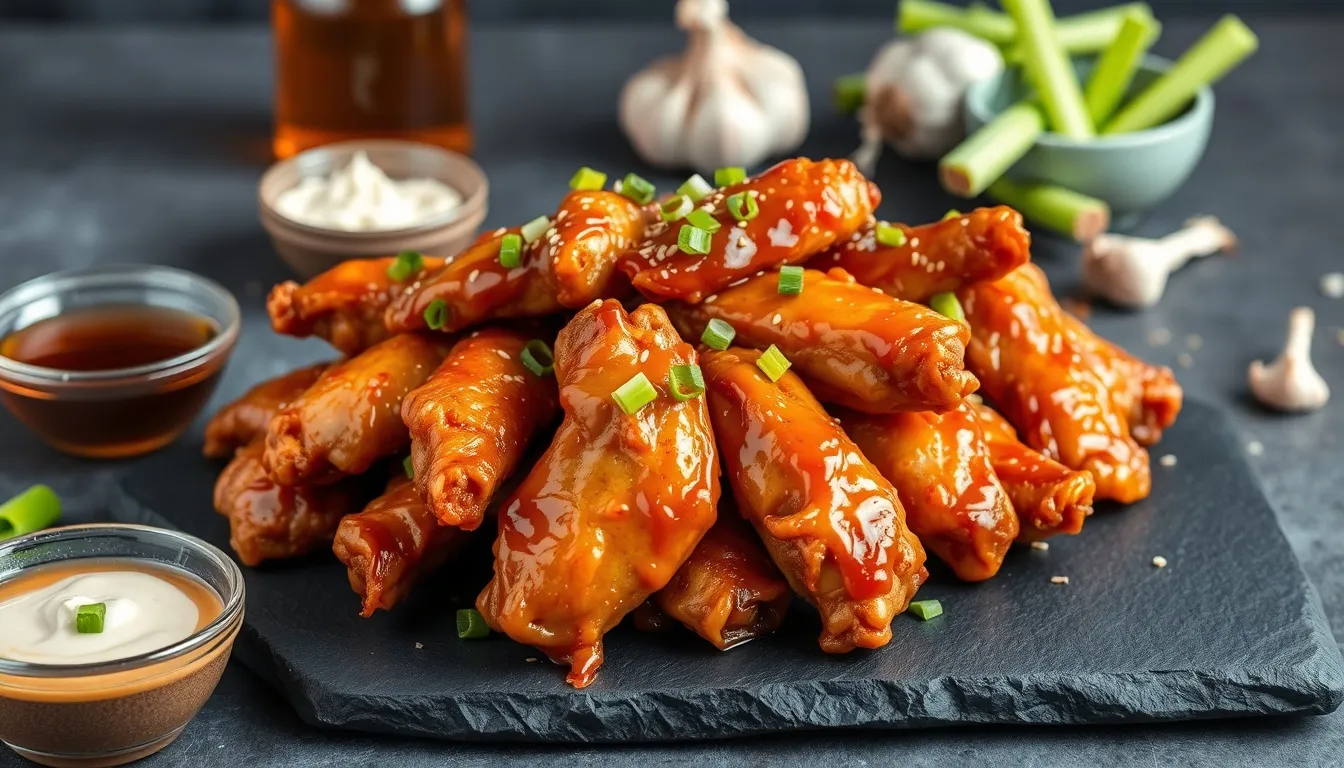
This is an illustration of the finished dish, not a photograph of a kitchen-tested batch. Follow the recipe card quantities and thermometer instructions.
USDA raw-input nutrition estimate
The USDA Standard Reference Release 28 row for NDB 05100 assigns 38% raw refuse to bone and connective tissue in whole wings. The calculation uses 1360.77711 g purchased whole wings × 62% = 843.6818082 g raw edible meat and skin. This historical average is an input estimate, not the measured yield of your wings. It does not apply to a pre-trimmed bag. All sauce ingredients are included; rendered fat left on the tray is not subtracted with an invented cooking-loss factor.
USDA input edible weights divided by yield; no cooking-loss or discarded-food adjustment assumed. FDC 172390: raw purchased weight × 0.62 edible fraction from USDA SR28 NDB 05100 (Bone and connective tissue 38%); this excludes raw refuse only, not cooking loss, brine uptake or absorbed marinade.
The values are ingredient estimates, not laboratory measurements, kitchen testing or a measured cooked serving. Bones and connective tissue are excluded using the stated source; actual cooking losses and optional preparations are not silently guessed.
- USDA FoodData Central 172390
- USDA FoodData Central 172803
- USDA FoodData Central 173468
- USDA FoodData Central 170931
- USDA FoodData Central 171325
- USDA FoodData Central 169640
- USDA FoodData Central 174277
- USDA FoodData Central 169230
- USDA FoodData Central 173469
- USDA FoodData Central 171016
- USDA FoodData Central 173430
- USDA FoodData Central 169698
- USDA FoodData Central 173647
- USDA SR28 raw-food source archive
Cooking and storage references
Use the FoodSafety.gov temperature chart for the internal endpoint. The government roasting chart gives planning times, not a substitute for a thermometer.
Refrigerate cooked leftovers promptly in shallow covered containers. The government cold-storage chart lists 3–4 days for cooked meat or poultry; reheat leftovers to 165°F (74°C).