Why Homemade Honey Mustard Is Worth Making
Honey mustard is one of the most versatile sauces in any kitchen — a dipping sauce, salad dressing, sandwich spread, and meat glaze all in one. And the homemade version takes about two minutes to make with ingredients you probably already have.
Store-bought honey mustard typically contains high-fructose corn syrup, preservatives, and artificial flavors. You also control the sweetness, tanginess, and heat level.
The basic formula is simple: equal parts honey and mustard, plus a splash of acid and a pinch of seasoning. From there, five variations cover every use case from chicken nugget dipping sauce to holiday ham glaze.
Classic Honey Mustard Sauce: The Base Recipe
This foundational recipe works as a dipping sauce, sandwich spread, or light dressing. Master it first, then try the variations below.
- **Ingredients:** 1/4 cup raw honey (preferably clover or wildflower); 1/4 cup Dijon mustard; 1 tablespoon apple cider vinegar or lemon juice; pinch of salt; pinch of garlic powder (optional).
- **Step 1: Combine honey and mustard** — Whisk together the honey and Dijon mustard in a small bowl until completely smooth. If your honey is crystallized, gently warm it for 10 seconds in the microwave first.
- **Step 2: Add the acid** — Stir in the apple cider vinegar or lemon juice. This brightens the flavor and balances the sweetness. Apple cider vinegar adds a rounded tang; lemon juice gives a sharper, fresher bite.
- **Step 3: Season** — Add a pinch of salt and garlic powder if using. Whisk again until uniform.
- **Step 4: Taste and adjust** — Want it sweeter? Add more honey, a teaspoon at a time. More tangy? Add another splash of vinegar. More mustardy? Add another tablespoon of Dijon.
Pro Tip
The ratio is flexible. Start at 1:1 honey to mustard and adjust from there. For a sweeter dipping sauce, go 2:1 honey to mustard. For a tangier dressing, go 1:2.
Get the Honey Buyer's Cheat Sheet (free PDF)
16 varieties on one page — color, flavor, best use and what a fair price looks like — from the 268 honeys we track.
Choosing the Best Honey for Honey Mustard
The honey you choose noticeably affects the final flavor. With only four ingredients, the honey variety does a lot of the work.
- **Clover honey** — The classic choice. Clean, mild sweetness that lets the mustard lead. Best for: all-purpose dipping sauce, kids' preferred version.
- **Wildflower honey** — More complex with floral and herbal notes that add depth. Best for: salad dressings, roasted vegetable glazes.
- **Orange blossom honey** — Light citrus notes that complement lemon juice beautifully. Best for: seafood dipping sauce, citrus salad dressing.
- **Buckwheat honey** — Dark, robust, almost molasses-like. Creates a bold, complex honey mustard. Best for: red meat glazes, barbecue-style dipping.
- Carbohydrate note — Honey remains an added-sugar carbohydrate.
- **Hot honey** — Already spiced with chili flakes. Shortcut to spicy honey mustard without adding extra ingredients.
Pro Tip
Use raw honey rather than ultra-processed honey for better flavor complexity. The enzymes and pollen in raw honey add subtle depth that processed honey can't match.
5 Honey Mustard Variations
Each variation starts with the base recipe above and adds a twist for a specific use case.
- **1. Creamy honey mustard dressing** — Add 2 tablespoons of mayonnaise (or Greek yogurt for a lighter version) and 1 tablespoon of water to the base recipe. Whisk until smooth and pourable. This is the classic salad dressing version — thick enough to coat greens without drowning them. The yogurt variation adds probiotics and protein.
- **2. Spicy honey mustard** — Add 1/2 teaspoon cayenne pepper, 1 teaspoon sriracha, or 1 tablespoon hot honey to the base recipe. The sweet-heat combination is addictive on chicken tenders, pretzels, and egg rolls. Adjust the heat level up or down to taste.
- **3. Honey mustard glaze** — Reduce the vinegar to 1 teaspoon and add 1 tablespoon of soy sauce (or tamari for gluten-free) and 1 teaspoon of olive oil. Brush on chicken, salmon, pork chops, or ham during the last 10 minutes of cooking. The sugars in honey caramelize at around 320°F, creating a glossy, sticky finish.
- **4. Honey mustard vinaigrette** — Add 3 tablespoons of extra virgin olive oil and 1 extra tablespoon of vinegar to the base recipe. Whisk vigorously or shake in a jar to emulsify. The mustard acts as a natural emulsifier, keeping the oil and vinegar from separating. Perfect on mixed greens, grain bowls, and roasted vegetable salads.
- **5. Ranch-style honey mustard** — Add 2 tablespoons of mayonnaise, 1 tablespoon of buttermilk, 1/4 teaspoon each of dried dill, onion powder, and garlic powder to the base recipe. This creamy, herb-flecked version is the ultimate dipping sauce for chicken strips, sweet potato fries, and pizza crust.
10 Ways to Use Honey Mustard
Honey mustard is far more versatile than most people realize. Here are ten ways to put it to work.
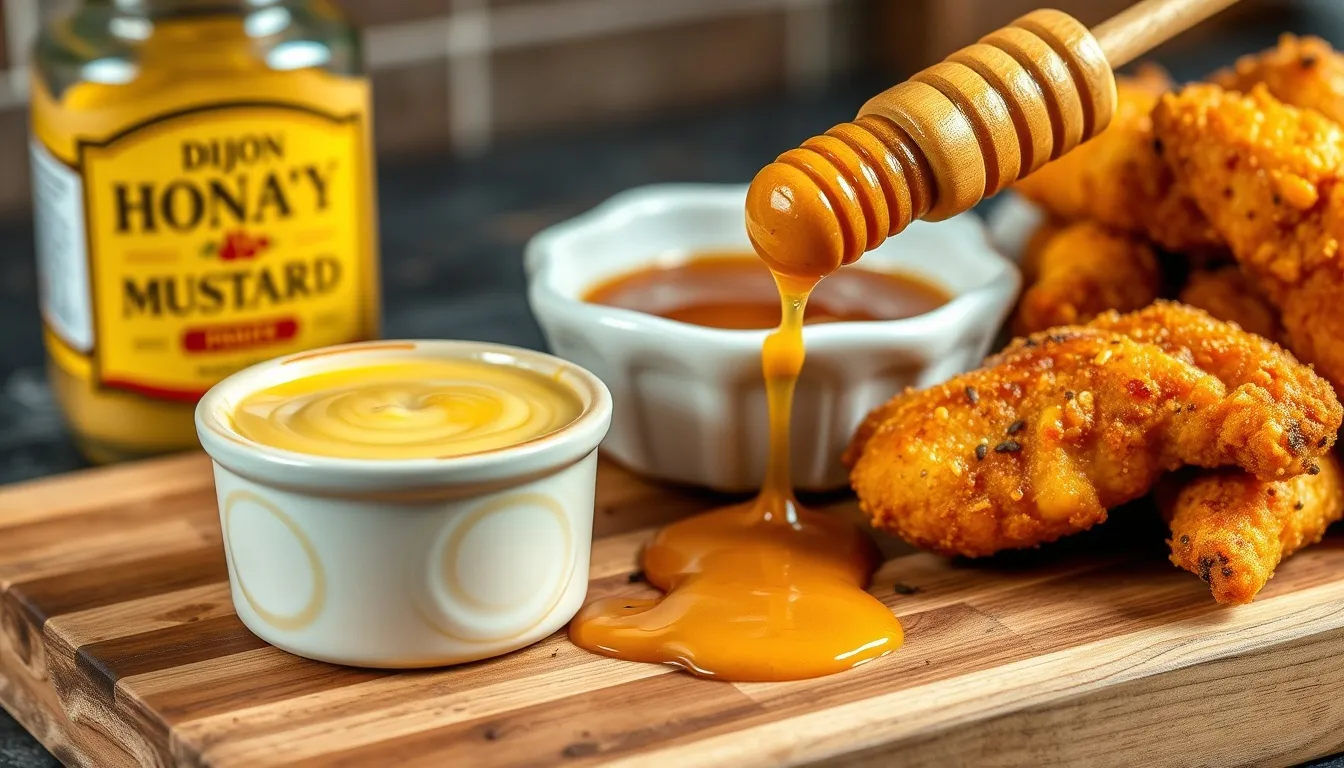
- **1. Chicken dipping sauce** — The classic use. Serve alongside baked, fried, or grilled chicken tenders, nuggets, or wings. The sweet-tangy flavor complements both crispy breading and smoky char.
- **2. Salad dressing** — Use the vinaigrette or creamy variation on mixed greens, spinach salads, or grain bowls. Pairs especially well with salads featuring apples, pecans, dried cranberries, or goat cheese.
- **3. Sandwich and wrap spread** — Replace plain mustard or mayo with honey mustard on turkey clubs, chicken wraps, ham sandwiches, and veggie wraps. It adds both flavor and moisture.
- **4. Meat and fish glaze** — Brush the glaze variation on chicken breasts, pork tenderloin, salmon fillets, or holiday ham. Apply during the last 10-15 minutes of cooking to prevent burning.
- **5. Pretzel dip** — Soft or hard pretzels with honey mustard is a pub classic. The salty-sweet combination works because salt suppresses bitterness and enhances sweetness.
- **6. Roasted vegetable drizzle** — Toss Brussels sprouts, carrots, sweet potatoes, or cauliflower with honey mustard glaze before roasting at 400°F. The honey caramelizes and the mustard adds a tangy crust.
- **7. Marinade base** — Thin the base recipe with 2 tablespoons of olive oil and use as a marinade for chicken, pork, or tofu. Marinate 2-4 hours (the acid in vinegar and mustard tenderizes proteins).
- **8. Grain bowl sauce** — Drizzle honey mustard vinaigrette over rice bowls, quinoa bowls, or Buddha bowls for an instant flavor upgrade.
- **9. Charcuterie board condiment** — Serve in a small ramekin alongside charcuterie meats, cheeses, crackers, and honeycomb. It pairs exceptionally well with sharp cheddar, brie, and prosciutto.
- **10. Deviled egg filling** — Replace plain mustard with honey mustard in your deviled egg recipe. The touch of sweetness balances the richness of the yolk and mayo.
The Science Behind Honey Mustard
Honey mustard works so well because of complementary flavor chemistry. Mustard contains isothiocyanates — pungent compounds released when mustard seeds are crushed — that stimulate the trigeminal nerve (the same nerve that registers wasabi and horseradish heat). Honey's natural sugars suppress this pungency while enhancing the perception of other flavors through a phenomenon called "sweetness-induced flavor enhancement."
The acid (vinegar or lemon) serves two purposes: it preserves the isothiocyanates' pungency by maintaining a low pH (without acid, mustard goes flat over time), and it brightens the overall flavor by stimulating sour taste receptors that make the other flavors pop.
When used as a glaze, the chemistry shifts. Honey's fructose and glucose undergo the Maillard reaction and caramelization at oven temperatures (300-400°F), creating hundreds of new flavor compounds that give glazed food its characteristic golden-brown color and complex sweetness. This is why honey-based glazes outperform sugar-based ones — honey's fructose caramelizes at a lower temperature than sucrose, producing a glossier finish at gentler heat.
Choosing the Right Mustard
The type of mustard matters almost as much as the honey. Here's how each type affects the result.
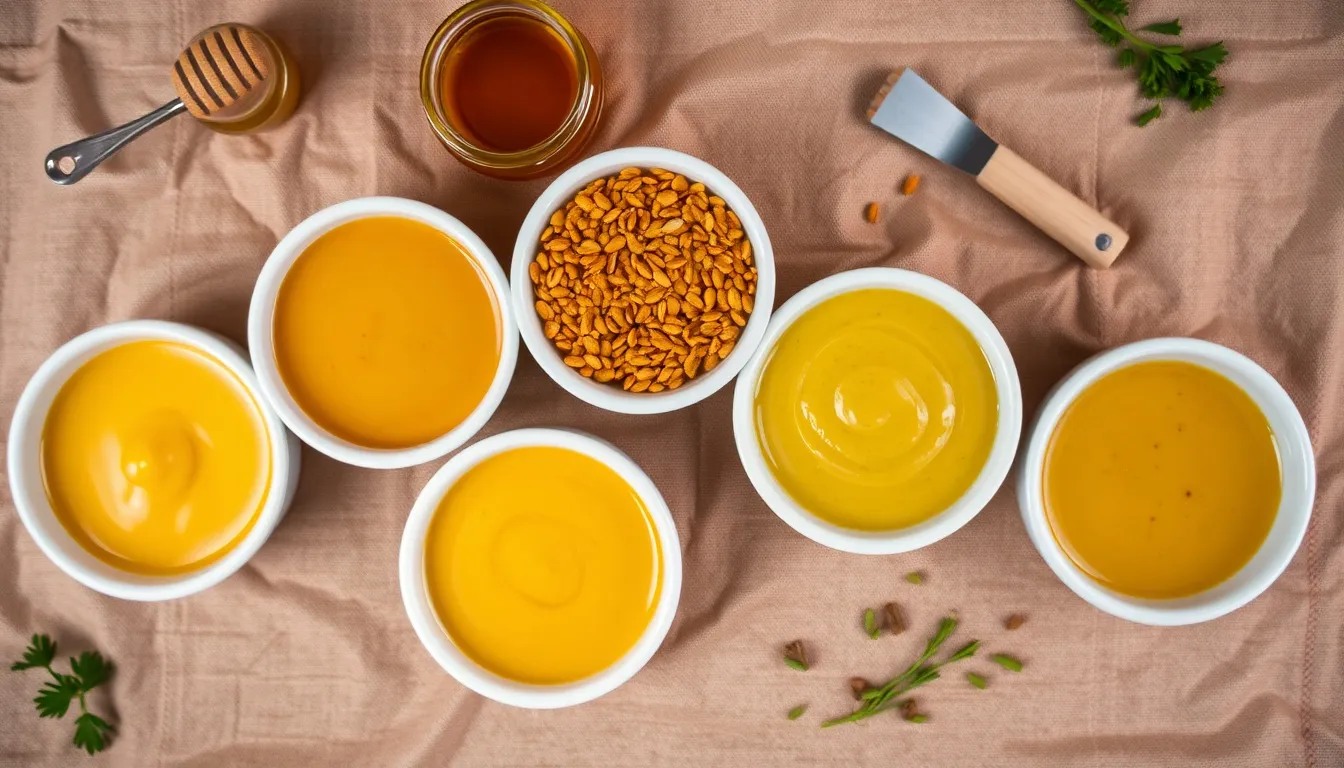
- **Dijon mustard** — The best all-purpose choice. Smooth, moderately sharp, and emulsifies well. Made with brown or black mustard seeds and verjuice (or vinegar). Use for: dressings, dipping sauces, glazes.
- **Yellow mustard** — Milder and tangier than Dijon, with turmeric for color. Creates a sweeter, less complex honey mustard familiar from fast-food restaurants. Use for: kid-friendly dipping sauce, casual barbecue.
- **Whole-grain mustard** — Dijon-style but with visible mustard seeds for texture. Creates a rustic honey mustard with pops of heat from whole seeds. Use for: charcuterie boards, sandwich spreads, gourmet applications.
- **Spicy brown mustard** — Coarser than Dijon with more heat. Makes a bolder honey mustard that stands up to robust meats like pastrami, sausage, and smoked pork.
- **Blend** — For the best of all worlds, mix 2 tablespoons Dijon with 1 tablespoon whole-grain mustard. You get smoothness from the Dijon and texture from the whole-grain.
Storage and Shelf Life
Homemade honey mustard stores well thanks to honey's natural antimicrobial properties and mustard's high acid content.
- **Refrigerated (2-3 weeks)** — Store in an airtight jar or container. The flavors actually improve after a day as the ingredients meld. Stir or shake before using, as the oil in vinaigrette versions may separate.
- **Freezing (not recommended)** — Mustard-based sauces don't freeze well. The emulsion breaks and the texture becomes grainy upon thawing.
- **Room temperature (1-2 days)** — Safe for a day at room temperature for a party or barbecue spread, but refrigerate leftovers promptly.
Pro Tip
Make a double or triple batch of the base recipe and store it in a squeeze bottle in the fridge. Having honey mustard ready to go makes weeknight salads and meal prep dramatically easier.
Common Mistakes to Avoid
Honey mustard is simple, but a few common errors can affect the result.
- **Using processed honey** — Cheap honey blended with corn syrup produces a flat, one-dimensional sweetness. Real honey has floral complexity that makes the sauce sing.
- **Skipping the acid** — Without vinegar or lemon juice, honey mustard tastes cloying and flat. The acid provides essential balance and brightness.
- **Wrong ratio for the use case** — A dipping sauce needs a different honey-to-mustard ratio than a glaze or dressing. Adjust the ratio to match how you're using it (sweeter for dipping, tangier for dressing, thicker for glazing).
- **Over-heating honey in glazes** — When making a glaze, add the honey mustard during the last 10-15 minutes of cooking. Applied too early, the sugars burn and turn bitter rather than caramelizing into a glossy finish.
- **Not tasting as you go** — Honey sweetness varies significantly by variety. Buckwheat honey needs less volume than mild acacia honey to achieve the same perceived sweetness. Always taste and adjust.
Honey Mustard vs Store-Bought: What's the Difference?
The ingredient list tells the story. A typical store-bought honey mustard lists: water, sugar, distilled vinegar, honey (often third or fourth ingredient), mustard seed, corn syrup, salt, xanthan gum, natural flavors, turmeric, paprika. Honey is often a minor player, with sugar and corn syrup doing most of the sweetening.
The flavor difference is noticeable: homemade tastes brighter, more complex, and less artificially sweet.
Cost-wise, a batch of homemade honey mustard costs roughly $1-2 for about a cup of sauce (depending on honey quality), compared to $3-5 for an 11-ounce bottle of premium store-bought. And you can customize every batch.