Why Honey Garlic Meatballs Work So Well
These meatballs bake first, then finish in a honey-garlic glaze in the same roasting pan. The sauce goes into the hot pan only after the beef is cooked, so it has a short finish rather than a long chance to scorch.
The base makes about 24 small meatballs, or four dinner portions. It uses plain dry breadcrumbs and cider vinegar, both stated explicitly below. Choose clover honey for a mild sauce or wildflower honey for a more floral one.
Recipe
Honey Garlic Meatballs
Bake honey garlic meatballs in one roasting pan, then add a sticky glaze. Includes five sauce variations and a thermometer check for the beef meatballs.
13Ingredients
Yield: 4 servings
- 453.59 g ground beef, 80% lean and 20% fat (1 pound)
- 25 g plain dry breadcrumbs
- 50 g whole egg, shell removed (1 large egg)
- 18 g garlic, minced, divided into 6 g for the meatballs and 12 g for the glaze
- 3 g fine salt (1/2 teaspoon)
- 0.58 g ground black pepper (about 1/4 teaspoon)
- 0.6 g onion powder (1/4 teaspoon)
- 112 g honey
- 48 g soy sauce (3 tablespoons)
- 15 g cider vinegar (1 tablespoon)
- 4.5 g sesame oil (1 teaspoon)
- 8 g cornstarch (1 tablespoon)
- 30 g cold water (2 tablespoons)
Ingredient amounts scale; instructions show the original batch. Cooking times and pan sizes may need adjustment. Season to taste. Honey grams use US measures at 20°C and 17.5% moisture, a density estimate; weigh your honey for precision.
Instructions
- 1Mix and shapeHeat the oven to 400°F (200°C). Mix the beef, breadcrumbs, egg, 6 g garlic, salt, pepper and onion powder until just combined. Divide into 24 small meatballs. Arrange in a metal roasting pan with a little space between them.
- 2Bake the meatballsBake for about 15–18 minutes. Check the center of several meatballs with a thermometer: ground beef must reach 160°F (71°C). Keep any juices and rendered fat in the pan for this full-input version.
- 3Mix the glazeWhile the meatballs bake, whisk the honey, soy sauce, remaining 12 g garlic, cider vinegar and sesame oil in a bowl. Stir the cornstarch with the cold water in a separate small cup, then whisk it into the glaze.
- 4Finish in the same panPour the glaze over the cooked meatballs and turn gently to coat. Return the pan to the oven for about 5–7 minutes, stirring once, until the sauce bubbles and thickens. Check that the meatballs remain at least 160°F before serving.
- 5Serve four portionsDivide into four portions of about six meatballs with the sauce. Rice, noodles and garnishes are outside the base recipe estimate. If you drain off the rendered fat, the published full-input estimate no longer describes that change.
Estimated nutrition per serving
448.01 calories · 25.42 g fat · 31.82 g carbohydrate · 23.3 g protein · 1090.83 mg sodium
Serving: 1 of 4 servings
Calculated from ingredient weights and USDA FoodData Central: 174036, 174928, 171287, 169230, 173468, 170931, 171327, 169640, 174277, 173469, 171016, 169698, 173647. Estimates use ingredient input weights; actual portions, brands and cooking losses vary. Omitted nutrient values are unavailable, not zero.
Choosing the honey for this batch
The best honey for cooking depends on how much honey flavor you want beside the other ingredients. A mild clover jar is a useful starting point; wildflower varies with its nectar sources, so taste it before adding stronger seasonings.
The map is an editorial flavor guide, on a relative 1–5 intensity scale. It is not a measured sweetness or nutrient chart. Pick one variety for the measured base; optional flavor variations below change its ingredients.
1 = mild, 5 = bold. Editorial pairing guidance, not laboratory measurements; jars vary.
- Clover
- Mild glazed vegetables and savory sauces
- Wildflower
- Roasted vegetables and garlic
- Buckwheat
- Smoky or spiced glazes
Matching a honey to another dish: the honey flavor map
Get the Honey Buyer's Cheat Sheet (free PDF)
16 varieties on one page — color, flavor, best use and what a fair price looks like — from the 304 honeys we track.
Choosing the Best Honey
The honey you choose makes a genuine difference because it contributes both sweetness and flavor to a sauce with very few ingredients.
- Wildflower honey — Our top pick. Multi-floral complexity adds depth to the garlic without overwhelming umami elements, creating the most balanced sticky glaze. Medium caramelization produces perfect texture for coating meatballs evenly.
- Clover honey — Clean, mild sweetness that lets garlic and soy sauce flavors dominate while thickening into a glossy coating. Most neutral, crowd-pleasing option for family dinners.
- Orange blossom honey — Subtle citrus notes add brightness that complements the sesame ginger variation beautifully. Light floral character creates aromatic glaze perfect for entertaining.
- Buckwheat honey — Bold, molasses-like intensity creates deeper, almost BBQ-style glaze with rich caramelized complexity. Outstanding for spicy and BBQ variations requiring robust honey backbone.
- Acacia honey — Delicate, very mild profile allows garlic to dominate while providing clean sweetness and light golden color. Creates the most refined, well-browned appearance.
Pro Tip
For extra depth, try fermented honey garlic in place of the fresh garlic and half the honey. The fermentation adds complex umami that elevates the sauce to restaurant-level.
5 Flavor Variations
Each variation modifies the sauce while keeping the same meatball base. Switch the protein too — ground chicken, turkey, or pork all work with any variation.
- Sesame Ginger: Add 1 tablespoon grated fresh ginger and 1 extra teaspoon sesame oil to the sauce. Double the sesame seed garnish. Orange blossom honey pairs beautifully with ginger's warmth. Serve over jasmine rice with steamed bok choy. The ginger adds brightness that cuts through the sweetness, as in honey and ginger combinations.
- Spicy Honey Garlic: Add 1-2 tablespoons sriracha or sambal oelek and 1/2 teaspoon red pepper flakes to the sauce. Wildflower honey or clover honey provide balanced sweetness that doesn't compete with heat. The sweet-spicy pairing makes an addictive contrast — the heat builds while the honey rounds it off.
- Teriyaki Style: Replace rice vinegar with 2 tablespoons mirin. Add 1 tablespoon extra soy sauce. Acacia honey creates the cleanest teriyaki glaze without competing with umami complexity. Garnish with nori strips and furikake. Serve over short-grain rice. Deeper umami profile than the base recipe.
- Honey BBQ: Add 2 tablespoons tomato paste, 1 teaspoon smoked paprika, and 1/2 teaspoon cumin to the sauce. Use buckwheat honey for extra depth. Serve with coleslaw and cornbread — try the honey cornbread recipe.
- Sweet Chili: Replace soy sauce with sweet chili sauce. Add 1 tablespoon lime juice and a pinch of cayenne. Orange blossom honey adds citrus notes that complement lime beautifully. Garnish with fresh cilantro and crushed peanuts. Lighter, brighter, and Thai-inspired.
Serving Ideas
Honey garlic meatballs are remarkably versatile — they work as a main course, appetizer, or meal prep base.
- Over rice: Steamed jasmine or short-grain rice absorbs the extra sauce perfectly. Drizzle any remaining glaze from the pan over the rice.
- With noodles: Toss with lo mein noodles, udon, or ramen noodles. The sauce coats noodles just as well as meatballs.
- Lettuce wraps: Serve 2-3 meatballs in butter lettuce cups with shredded carrots, cucumbers, and a drizzle of extra honey garlic sauce.
- Appetizer skewers: Thread onto toothpicks or mini skewers for party appetizers. The sticky glaze keeps them finger-food friendly.
- Sub sandwich: Split a hoagie roll, add 4-5 meatballs with extra sauce, top with provolone, and broil until melty.
- Meal prep bowls: Pair with roasted vegetables and grain of choice. Meatballs reheat well for 3-4 days in the refrigerator.
Serving the finished dish
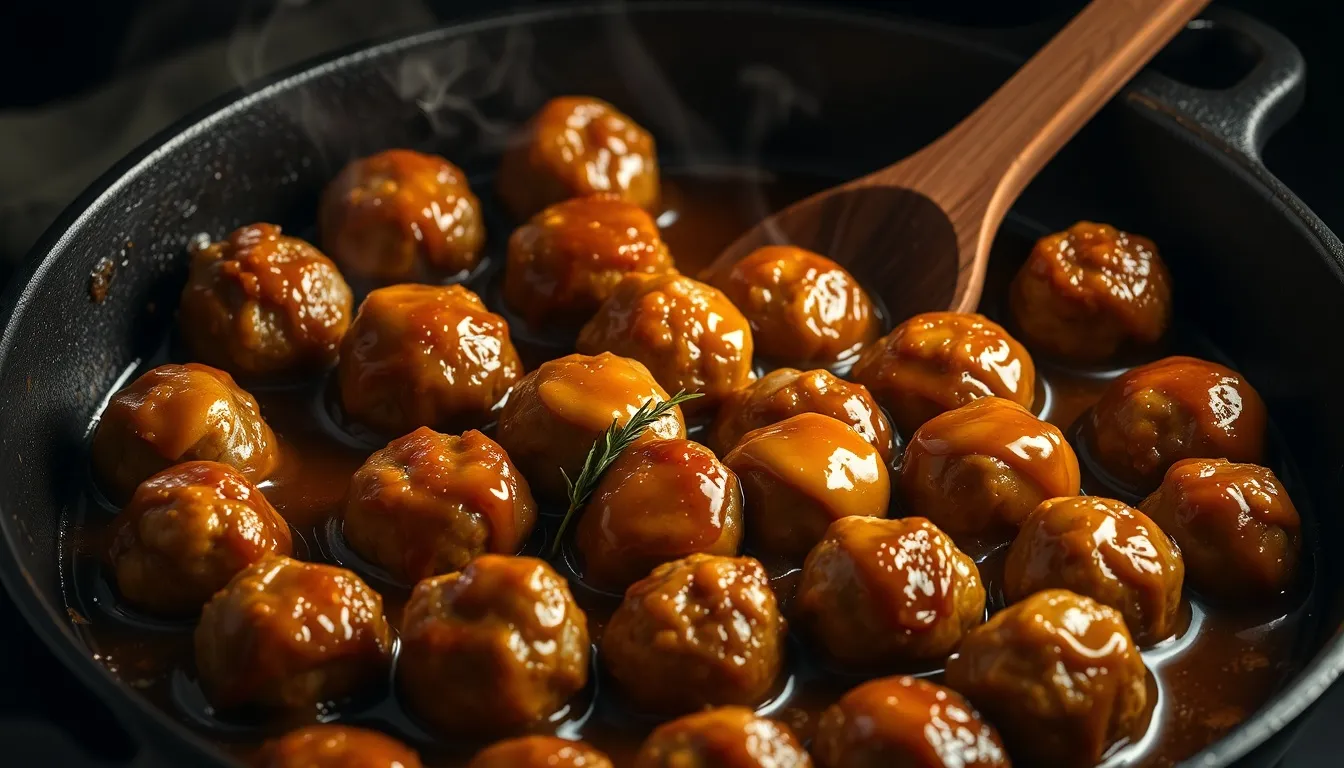
The image is an illustration of the dish, not a photograph of a tested batch. Use the quantities and method in the recipe card for the measured base.
Storage and reheating
Refrigerate leftovers promptly in shallow covered containers. Use cooked meat within 3–4 days and reheat leftovers to 165°F (74°C), as listed in the government storage chart and temperature chart.
Keep additional serving sauce separate from a brush or utensil that has touched raw meat. Start with clean plates and utensils when the cooked food is ready.
Ingredient-weight nutrition estimate
This is an ingredient-input estimate for one quarter of the batch, including all beef fat, sauce and pan juices. No draining or cooking-loss factor is invented. Draining fat, changing the meat or serving with rice changes the result.
USDA input edible weights divided by yield; no cooking-loss or discarded-food adjustment assumed.
The values are calculated estimates from USDA ingredient records, not laboratory measurements or evidence of kitchen testing. Portion size and the ingredients actually used matter more than the display precision.
- USDA FoodData Central 174036
- USDA FoodData Central 174928
- USDA FoodData Central 171287
- USDA FoodData Central 169230
- USDA FoodData Central 173468
- USDA FoodData Central 170931
- USDA FoodData Central 171327
- USDA FoodData Central 169640
- USDA FoodData Central 174277
- USDA FoodData Central 173469
- USDA FoodData Central 171016
- USDA FoodData Central 169698
- USDA FoodData Central 173647
Temperature reference
FoodSafety.gov’s temperature chart is the source for the endpoint stated in the recipe card. Check the food with a thermometer; browning and elapsed time do not establish the internal temperature.