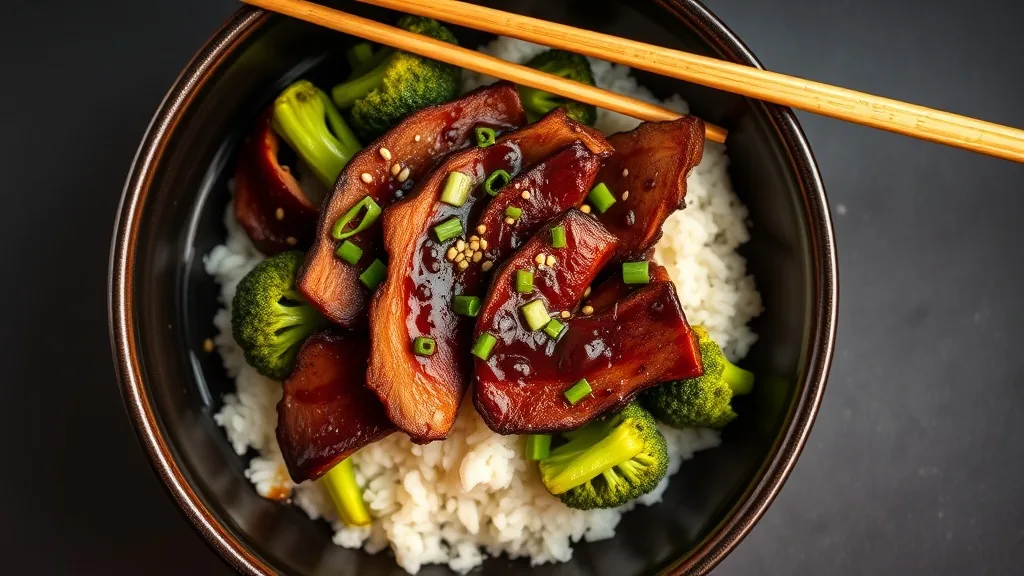
A honey-soy stir-fry with room for broccoli
Thinly sliced beef and broccoli cook quickly in a glossy honey-soy sauce. This base uses a weighed lean flank steak and broccoli, with soy sauce and sesame oil divided between the coating and the glaze.
The short starch-coating rest overlaps chopping the broccoli and mixing the sauce. Allow about 30 minutes with ingredients ready to prepare. A small skillet needs more batches and therefore more cooking time.
Recipe
Honey Soy Beef and Broccoli
Thin-sliced lean flank steak and broccoli in a honey-soy glaze. Four servings in about 30 minutes, with the short coating rest overlapping preparation.
12Ingredients
Yield: 4 servings
- 680 g raw lean flank steak, visible outer fat trimmed
- 500 g raw broccoli florets
- 3 tablespoons clover honey (63 g)
- 4 tablespoons soy sauce (64 g), divided
- 15 mL Mizkan unseasoned rice vinegar
- 3 teaspoons sesame oil (13.5 g), divided
- 4 cloves garlic (12 g), minced
- 6 g fresh ginger, finely grated
- 16 g cornstarch, divided
- 90 g water, divided
- 2 tablespoons olive oil (27 g), divided
- 0.5 g ground cayenne
Ingredient amounts scale; instructions show the original batch. Cooking times and pan sizes may need adjustment. Season to taste. Honey grams use US measures at 20°C and 17.5% moisture, a density estimate; weigh your honey for precision.
Instructions
- 1Slice and coat the beefSlice the trimmed steak thinly across the grain. Toss with 8 g cornstarch, 1 tablespoon of the measured soy sauce and 1 teaspoon sesame oil. Rest for about 10 minutes while preparing the broccoli and sauce.
- 2Mix the sauceWhisk honey, remaining soy sauce and sesame oil, rice vinegar and cayenne. In another cup, mix the remaining 8 g cornstarch with 30 g of the measured cold water.
- 3Cook the broccoliHeat half the olive oil in a large skillet or wok. Add broccoli, stir briefly, then add the remaining 60 g water. Cover for 2–3 minutes to steam, uncover and cook until the florets are as tender as you like. Transfer to a bowl.
- 4Cook the beefAdd the remaining olive oil. Cook the coated beef in uncrowded batches, turning until browned and the thickest pieces reach 145°F (63°C). Move to a clean plate and allow at least a 3-minute rest while making the sauce.
- 5Finish the stir-fryLower heat and stir garlic and ginger in the pan for about 30 seconds. Add the honey mixture, bring to a simmer, stir the slurry again and whisk it in. Return beef and broccoli and toss until glossy and hot. Divide into 4 portions; rice and garnish are separate.
Estimated nutrition per serving
462.97 calories · 21.42 g fat · 27.05 g carbohydrate · 42.01 g protein · 1019.32 mg sodium
Serving: 1/4 complete base batch
Calculated from ingredient weights and USDA FoodData Central: 168609, 170379, 169640, 174277, 2083928, 171016, 169230, 169231, 169698, 173647, 171413, 170932. Estimates use ingredient input weights; actual portions, brands and cooking losses vary. Omitted nutrient values are unavailable, not zero.
Slice across the grain and prepare the sauce first
Look for the long muscle fibers in the steak and cut across them, not along them. Thin, even slices are easier to cook consistently than a mixture of thick blocks and fine strips. A light starch coating helps the sauce cling to the slices.
Have the sauce and cold-water slurry ready before the pan gets hot. Cornstarch settles in a cup, so stir it again just before adding. Steaming the broccoli briefly gives the stems time to soften without requiring the beef to wait in the hot pan.
Use 145°F (63°C) with a 3-minute rest for whole-cut beef as the minimum used here. Check a thick piece with a suitable thermometer and do not use a pink center or browned surface as the only doneness test.
Get the Honey Buyer's Cheat Sheet (free PDF)
16 varieties on one page — color, flavor, best use and what a fair price looks like — from the 304 honeys we track.
Choose the honey for this sauce
Clover honey is mild, wildflower honey adds floral character, orange blossom honey gives a citrus-floral note, and buckwheat honey tastes darker and maltier. The pairing guide has more choices.
The chart uses an editorial 1–5 flavor-intensity scale. It is a pairing aid; the honey in a particular jar can taste different from another harvest.
1 = mild, 5 = bold. Editorial pairing guidance, not laboratory measurements; jars vary.
- Clover
- Classic honey-soy glaze
- Orange blossom
- Citrus stir-fry variation
- Wildflower
- Ginger and broccoli
- Buckwheat
- Bold savory glaze
Matching a honey to another dish: the honey flavor map
5 flavor variations
These changes are separate from the base calculation. Keep the pan method and doneness checks, then adjust one flavor at a time.
- Extra ginger: Add another teaspoon of finely grated ginger with the garlic.
- Citrus: Stir lemon or orange zest into the finished sauce.
- Sesame finish: Add toasted sesame seeds at serving.
- More heat: Increase cayenne in small amounts after tasting the cooked sauce.
- Other vegetables: Replace part of the broccoli with sliced peppers or snap peas, adjusting their cooking time and recording the changed ingredients.
Serve the stir-fry and save the leftovers
Divide the beef, broccoli and sauce together so a serving includes its share of each. Rice, noodles and additional garnish are separate. Honey soy chicken, honey garlic sauce and honey ginger stir-fry offer related preparations with their own quantities.
Refrigerate cooked portions promptly in shallow covered containers and use within 3–4 days under USDA’s leftovers guidance. Reheat until hot throughout, adding a little water if the sauce has thickened.
Nutrition and ingredient evidence
One portion, 1/4 complete base batch, has an estimated 462.97 calories, 21.42 g fat, 6.01 g saturated fat, 27.05 g carbohydrate, 15.19 g sugars, 42.01 g protein, 1019.32 mg sodium. These are raw-ingredient input estimates divided by the recipe yield, not measurements of the plated food.
All measured beef, vegetables, coating, oil and sauce are allocated across 4 servings. Rice, garnish, pan residue and cooking losses are not measured corrections. The rice-vinegar record is a branded volume-based label estimate.
The ingredient records do not provide complete fiber values for this combination. Those fields are unavailable rather than reported as zero.
The branded ingredient values come from the source label, with its rounding limits. Volume-based records are calculated in milliliters, not converted to grams without a density. Different brands can change the estimate.
- USDA FoodData Central 168609: Beef, flank, steak, separable lean only, trimmed to 0" fat, choice, raw.
- USDA FoodData Central 170379: Broccoli, raw.
- USDA FoodData Central 169640: Honey.
- USDA FoodData Central 174277: Soy sauce made from soy and wheat (shoyu).
- USDA FoodData Central 2083928: RICE VINEGAR.
- USDA FoodData Central 171016: Oil, sesame, salad or cooking.
- USDA FoodData Central 169230: Garlic, raw.
- USDA FoodData Central 169231: Ginger root, raw.
- USDA FoodData Central 169698: Cornstarch.
- USDA FoodData Central 173647: Beverages, water, tap, drinking.
- USDA FoodData Central 171413: Oil, olive, salad or cooking.
- USDA FoodData Central 170932: Spices, pepper, red or cayenne.