Why Honey Is the Perfect Scrub Base
Walk into any spa or natural beauty store and you'll find honey listed in the premium tier of body scrubs — often at $30–$60 per jar. The good news: making an equally effective scrub at home costs under $5 and takes about five minutes. Raw honey brings three things to a body scrub that no synthetic alternative replicates: it's a natural humectant, a mild chemical exfoliant, and an antimicrobial agent, all in one ingredient.
As a humectant, honey draws moisture from the air into the skin's outer layers — which means it hydrates while it exfoliates instead of stripping moisture away like many sugar or salt scrubs do on their own. Honey contains gluconic acid, a gentle alpha hydroxy acid (AHA) that promotes cell turnover at the surface, and its enzymes (particularly glucose oxidase) produce a small, controlled amount of hydrogen peroxide on contact with skin, providing mild antimicrobial action without irritation.
The result: scrubbing with a honey-based formula removes dead skin cells, unclogs pores, delivers deep moisture, and leaves skin noticeably smoother — in a single step. The sugar or salt granules provide the physical exfoliation; the honey handles the chemical exfoliation, hydration, and preservation. For broader context on honey's skin benefits, see our honey for skin guide and our complete honey face mask recipes.
Pro Tip
Always use raw, unfiltered honey rather than pasteurized commercial honey. Heat processing destroys the enzymes and degrades many of the polyphenols that make honey effective for skin. Look for "raw" and "unfiltered" on the label, or buy directly from local beekeepers via our local honey sources directory.
Choosing the Right Honey for Body Scrubs
Not all honey varieties perform equally in body scrubs. The best choices depend on your skin type and the results you're after.
- **Raw wildflower honey** — The most versatile choice for most skin types. Complex polyphenol profile, mild scent that blends well with essential oils, medium viscosity ideal for scrub texture. Best all-purpose scrub base.
- **Manuka honey** — Highest antimicrobial activity due to methylglyoxal (MGO). Best choice for body acne-prone areas (back, chest, upper arms). More expensive but worth it for targeted antimicrobial use.
- **Acacia honey** — Very light, almost water-clear, and mild in scent. Ideal for sensitive skin and scented scrubs where you don't want honey aroma to compete with essential oils or botanicals.
- **Buckwheat honey** — Darkest color and strongest antioxidant profile. The molasses-like scent pairs well with coffee scrubs. Best for normal-to-oily skin that tolerates stronger ingredients.
- **Lavender honey** — Light floral notes that complement lavender essential oil scrubs naturally. Good choice for calming, relaxing bath-time scrubs.
- **Manuka honey for wounds/dry patches** — On particularly rough spots like elbows, knees, and heels, use a dab of high-UMF manuka honey as a spot treatment under the scrub for accelerated skin repair.
Get the Honey Buyer's Cheat Sheet (free PDF)
16 varieties on one page — color, flavor, best use and what a fair price looks like — from the 304 honeys we track.
Base Recipe: Honey Brown Sugar Body Scrub
This is the foundation recipe — simple, effective, and customizable. It suits all skin types including sensitive skin, and the three-ingredient formula produces results you'd expect from a $40 spa product.
**Ingredients:** ½ cup raw honey · ½ cup brown sugar (light or dark) · 2 tablespoons sweet almond oil (or any carrier oil)
**Instructions:** Combine honey and brown sugar in a glass jar and stir until fully mixed. The texture should be a thick, grainy paste — add more sugar for a coarser scrub or more honey for a gentler one. Stir in the carrier oil until incorporated. Use immediately or store in a sealed jar for up to 3 weeks at room temperature (up to 3 months refrigerated).
**To use:** In the shower or bath, wet skin, then scoop about a tablespoon of scrub and massage in circular motions for 30–60 seconds per area. Focus on knees, elbows, heels, and any rough patches. Rinse thoroughly. Follow with a light moisturizer if desired — though honey's humectant properties often make additional moisturizer unnecessary.
Pro Tip
Brown sugar dissolves faster than white granulated sugar, which means it's gentler and less likely to cause micro-tears on sensitive skin. For very sensitive skin, use ultra-fine sugar or substitute finely ground oats. For rough, calloused areas, use coarse sea salt instead for stronger exfoliation.
Variation 1: Honey Coffee Body Scrub
Coffee grounds are one of the most effective physical exfoliants available. The coarse texture removes dead skin cells aggressively, while caffeine temporarily tightens skin and improves circulation — which is why coffee scrubs have a reputation for temporarily reducing the appearance of cellulite. Combined with honey's hydration and antimicrobial properties, this is the most energizing scrub in this collection.
**Ingredients:** ½ cup finely ground coffee (used or fresh) · ¼ cup raw honey · 2 tablespoons coconut oil (melted) · 1 tablespoon brown sugar · ½ teaspoon vanilla extract (optional)
**Instructions:** Mix coffee grounds, honey, and melted coconut oil together. Add brown sugar and vanilla if using. The texture will be darker and coarser than the base recipe. This scrub is best used in the shower because coffee grounds can be messy — rinse the drain after use. Apply to damp skin in firm circular motions and rinse well. Coffee will temporarily stain white towels, so use a dark towel or rinse your skin under running water before patting dry.
Note: Caffeine from coffee scrubs is absorbed transdermally to a small degree. Avoid using this scrub in the evening if you're caffeine-sensitive.
Variation 2: Honey Oatmeal Body Scrub
Oatmeal has been used in dermatology for over a century for its soothing, anti-inflammatory properties. Colloidal oatmeal (finely ground oats) is an FDA-recognized skin protectant that relieves itch and irritation from conditions including eczema and dry skin. Combined with honey, this is the gentlest scrub in the collection — ideal for sensitive skin, eczema-prone skin, post-sun exposure, or anyone who finds other scrubs too abrasive.
**Ingredients:** ½ cup finely ground rolled oats (pulse in a blender until powder-fine) · ¼ cup raw honey · 2 tablespoons plain yogurt · 1 tablespoon sweet almond oil
**Instructions:** Mix ground oats and honey into a thick paste. Stir in yogurt and oil — the yogurt adds lactic acid (a mild AHA) and enhances the moisturizing effect. Apply to damp skin with gentle, slow circular motions. Leave on for 5 minutes as a treatment mask if desired, then rinse. This scrub is also excellent as a honey face mask applied carefully avoiding the eye area.
The lactic acid in yogurt works synergistically with honey's gluconic acid to promote gentle cell turnover without abrasion. If you have lactose intolerance or prefer dairy-free, substitute coconut yogurt — it works identically.
Variation 3: Honey Coconut Body Scrub
Honey and coconut oil is one of the most popular natural skincare combinations, and for good reason: coconut oil's lauric acid has documented antimicrobial activity against common skin bacteria, and its medium-chain fatty acids penetrate the skin's lipid barrier more effectively than many other carrier oils.
**Ingredients:** ½ cup raw honey · ½ cup white granulated sugar or coconut sugar · 3 tablespoons coconut oil (solid state for best texture) · 1 teaspoon fresh lime zest (optional) · 5 drops coconut or vanilla fragrance oil (optional)
**Instructions:** If your coconut oil is liquid (above 76°F), refrigerate briefly until it solidifies slightly — solid coconut oil gives the scrub a better, less greasy texture. Combine honey, sugar, and solid coconut oil in a bowl and beat with a fork until fluffy and combined. Fold in lime zest and fragrance if using. The texture should be scoopable with a slight fluffiness. Refrigerate in a sealed jar for up to 2 months.
Lime zest contributes natural limonene, a citrus compound with mild antimicrobial properties, and a fresh scent that makes this one of the most pleasant-smelling scrubs in the collection. Note: citrus compounds can increase photosensitivity — rinse thoroughly and avoid sun exposure immediately after use.
Variation 4: Honey Lemon Body Scrub
Lemon juice contains citric acid (an AHA), vitamin C (a brightening antioxidant), and natural bleaching compounds that can help fade dark spots, hyperpigmentation from old acne scars, and uneven skin tone over time. Combined with honey's gluconic acid, this creates a dual-AHA formula that's stronger than either ingredient alone.
**Ingredients:** ½ cup raw honey · ½ cup fine sea salt · 2 tablespoons fresh lemon juice (about 1 large lemon) · 1 tablespoon olive oil · 1 teaspoon lemon zest
**Instructions:** Whisk lemon juice into honey until fully incorporated. Stir in salt, olive oil, and lemon zest. Use immediately (fresh lemon juice doesn't preserve well) or refrigerate for up to 5 days. Apply to damp skin and massage for 30–45 seconds — the salt provides stronger exfoliation than sugar. Rinse thoroughly with cool water.
**Important caution:** Citric acid from lemon juice increases photosensitivity. Always use this scrub in the evening or at least 30 minutes before sun exposure, and apply SPF afterwards during the day. Avoid this scrub if you have open cuts, active sunburn, or very sensitive skin — the lemon juice will sting. For further reading on honey's brightening effects, see our posts on honey for dark spots and honey for skin.
Pro Tip
For a gentler citrus brightening scrub, substitute lemon essential oil (5–8 drops) for fresh lemon juice. Essential oil provides the scent and some of the benefits without the high acidity that causes stinging. This version is also shelf-stable for 2–3 months.
Variation 5: Honey Lavender Body Scrub
Lavender essential oil is one of the most studied aromatherapy ingredients, with documented anxiolytic (anti-anxiety) effects from inhalation in several randomized controlled trials. The combination of lavender scent and honey's tactile application creates a genuinely relaxing bathing experience beyond just skin benefits.
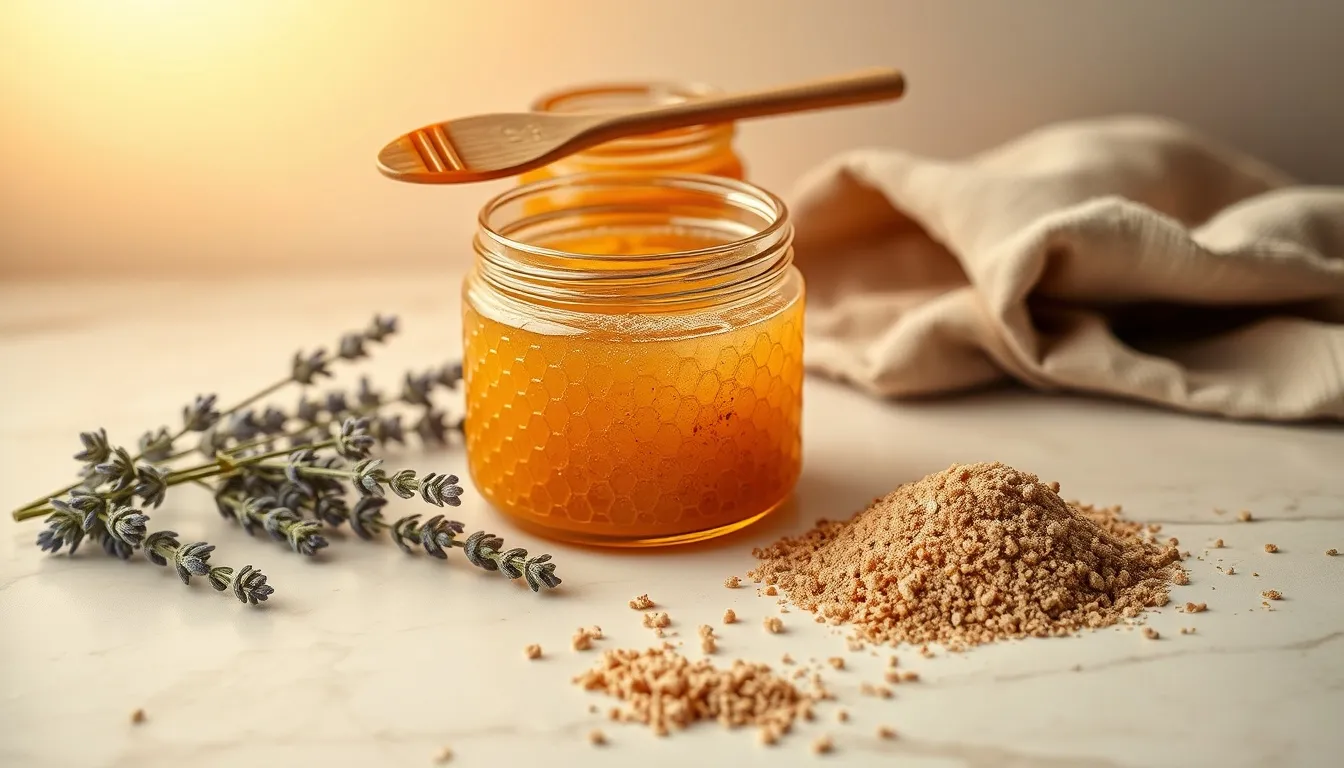
**Ingredients:** ½ cup raw honey (lavender honey if available) · ½ cup white sugar · 2 tablespoons sweet almond or jojoba oil · 10 drops lavender essential oil · 1 tablespoon dried lavender buds (optional, for visual and gentle exfoliation)
**Instructions:** Combine honey and sugar. Add carrier oil, lavender essential oil, and dried lavender buds if using. Stir well. The dried flowers provide a very gentle additional exfoliant and look beautiful in a glass jar. Store in a sealed container for up to 3 months at room temperature. Apply in slow, intentional circular motions and take a moment to breathe in the lavender aroma — the aromatherapy benefit is part of the experience.
For a stronger relaxation effect, consider pairing this scrub with an honey and milk bath soak — add 2 tablespoons of honey and 1 cup of whole milk or oat milk to warm bathwater before scrubbing.
Bonus: Honey Lip Scrub
The lips have some of the thinnest skin on the body and no oil glands, making them especially prone to dryness, flaking, and chapping. A honey lip scrub takes 30 seconds to make and produces noticeably softer lips in a single use. Unlike body scrubs, lip scrubs need to be edible — all ingredients below are food-safe.
**Ingredients:** 1 tablespoon raw honey · 1 tablespoon white sugar · ½ teaspoon coconut oil · 1 drop vanilla extract (optional)
**Instructions:** Stir all ingredients together in a small bowl or jar. Apply a pea-sized amount to lips and massage gently for 30–45 seconds with your fingertip. Rinse or lick off (it's delicious). Follow with a balm or a thin layer of raw honey left on for 5–10 minutes. The sugar exfoliates flakes and dead skin; the honey and coconut oil hydrate and seal in moisture.
Make a double batch and store in a small jar with a tight lid for up to 3 weeks. For honey's benefits specifically for lips, including evidence on healing chapped and cracked lips, see our dedicated guide.
How to Use Body Scrubs for Best Results
The technique matters as much as the formula. Common scrubbing mistakes reduce effectiveness and can even irritate skin.
- **Always scrub on damp skin.** Dry skin resists scrubs; wet skin is receptive. Apply in the shower or bath after the skin has been wet for 1–2 minutes. The warmth also opens pores slightly, making exfoliation more effective.
- **Use circular motions with light-to-medium pressure.** Gentle friction is more effective than aggressive scrubbing. Hard pressure can cause micro-abrasions, especially with coarser scrubs like coffee or sea salt. Think massage, not sanding.
- **Work from the feet upward.** This encourages lymphatic circulation in the same direction as natural lymph flow. Pay extra attention to the shins, knees, elbows, and upper arms where skin is naturally drier and thicker.
- **Leave it on briefly.** After scrubbing, let the honey mixture sit on the skin for 1–3 minutes before rinsing. This extends the chemical exfoliation and humectant effects — essentially turning your scrub into a brief honey mask.
- **Don't scrub more than 2–3 times per week.** Over-exfoliation removes the skin barrier faster than it can regenerate, leading to redness, sensitivity, and dryness. For most people, twice a week is ideal. For sensitive skin, once a week is enough.
- **Pat dry, don't rub.** After rinsing, pat skin dry with a towel. Rubbing can reintroduce friction and partially undo the smoothing effect. Apply any additional moisturizer while skin is still slightly damp to lock in the honey's humectant benefit.
Safety, Shelf Life, and Storage
Honey has natural preservative properties — its low water activity, acidic pH, and hydrogen peroxide production inhibit bacterial and fungal growth. This is why honey-based scrubs have significantly longer shelf lives than scrubs made with fresh fruits, dairy, or water-based ingredients.
- **Sugar and salt scrubs:** 2–3 months at room temperature in a sealed glass jar. Avoid introducing water into the jar (use a dry spoon or spatula to scoop), which reduces shelf life.
- **Scrubs with dairy (yogurt):** Use within 5 days refrigerated. Dairy shortens shelf life significantly.
- **Scrubs with fresh citrus juice:** Use within 5 days refrigerated.
- **Scrubs with essential oils only:** 3–6 months at room temperature. Essential oils are natural preservatives.
- **Glass containers are best.** Honey is acidic and can slowly leach compounds from plastic over time. Store in glass jars with tight-fitting lids — cleaned jam jars or mason jars work perfectly.
- **Patch test before full-body use.** Even natural ingredients can cause reactions in some people. Apply a small amount to the inner wrist and wait 20 minutes. If no redness or itching develops, the scrub is safe for broader use.
- **Do not use on open wounds, sunburned skin, or active rashes.** Wait for the skin to fully heal first.
Honey vs. Commercial Body Scrubs: What You're Paying For
A quick look at the ingredient list of a popular $35 "honey body scrub" from a major beauty retailer reveals the first ingredient is often water or glycerin, honey appears near the bottom of the list (meaning it's present in trace amounts), and preservatives and synthetic fragrance fill the middle. You're paying primarily for packaging, marketing, and shelf stability.
The DIY scrubs in this guide use honey as a primary ingredient — not a trace additive. A half-cup of quality raw honey in a scrub represents more honey than most commercial products use across an entire product line. The nutritional and bioactive compounds in honey — polyphenols, enzymes, amino acids, and organic acids — are present in meaningful concentrations that produce measurable results.
That said, DIY scrubs aren't inherently better in every way. Commercial products have standardized preservative systems, patch-tested formulas, and consistent texture. For travel, gifting, or convenience, a quality commercial scrub still has value. But for efficacy and value at home, a freshly made honey scrub using quality raw wildflower honey or buckwheat honey outperforms most commercial alternatives on every meaningful measure.