Why Honey Makes a Better Cheesecake
Sugar dissolves cleanly into cheesecake batter, but that is actually its weakness — it adds sweetness without adding anything else. Honey brings over 180 aromatic compounds, natural moisture retention, and a subtle floral depth that transforms a standard cheesecake into something far more interesting. A jar of clover honey ($9–15) or acacia honey ($9–16) is all you need to elevate the filling.
Honey is hygroscopic — it attracts and holds moisture. In a cheesecake, this means a creamier, denser filling that resists the drying and cracking that plagues sugar-sweetened versions. The fructose in honey also browns at a lower temperature than sucrose, producing a gorgeous golden top without overbaking the interior.
From a nutritional perspective, replacing sugar with honey means you need less total sweetener (honey is about 25% sweeter per tablespoon than sugar), and you gain a floral note that white sugar lacks entirely. Buckwheat honey ($9–23) is very dark and bold — better suited to other recipes. The cheesecake is still a dessert, just a more interesting one.
Classic Honey Cheesecake: The Complete Recipe
This recipe uses a water bath for crack-free results and a low oven finish for the creamiest possible texture. Plan ahead — the cheesecake needs at least 8 hours of refrigeration before serving.
- **Crust ingredients:** 1 1/2 cups graham cracker crumbs (about 12 full sheets); 3 tablespoons raw honey; 5 tablespoons unsalted butter, melted; pinch of salt.
- **Filling ingredients:** 4 packages (32 oz total) cream cheese, room temperature; 2/3 cup raw honey (clover $9–15, acacia $9–16, or orange blossom $12–24); 4 large eggs, room temperature; 1 cup sour cream, room temperature; 2 teaspoons vanilla extract; 2 tablespoons all-purpose flour; pinch of salt.
- **Step 1: Make the crust** — Preheat oven to 325°F (165°C). Mix graham cracker crumbs with melted butter, honey, and salt until it resembles wet sand. Press firmly into the bottom and 1 inch up the sides of a 9-inch springform pan. Bake for 10 minutes until set. Let cool while making the filling.
- **Step 2: Prepare the water bath** — Wrap the outside of the springform pan tightly in two layers of heavy-duty aluminum foil, bringing the foil up the sides to prevent water from seeping in. Place the wrapped pan inside a large roasting pan.
- **Step 3: Make the filling** — Beat cream cheese on medium speed for 3 minutes until completely smooth, scraping the bowl twice. Add honey and beat for 1 minute. Add eggs one at a time, beating on low just until each is incorporated. Add sour cream, vanilla, flour, and salt. Mix on low until just combined. Do not overbeat — excess air causes cracking.
- **Step 4: Pour and bake** — Pour filling over the cooled crust. Smooth the top with a spatula. Pour hot water into the roasting pan until it reaches halfway up the springform pan sides. Bake at 325°F for 55-65 minutes until the edges are set but the center still jiggles slightly (about a 3-inch wobble zone).
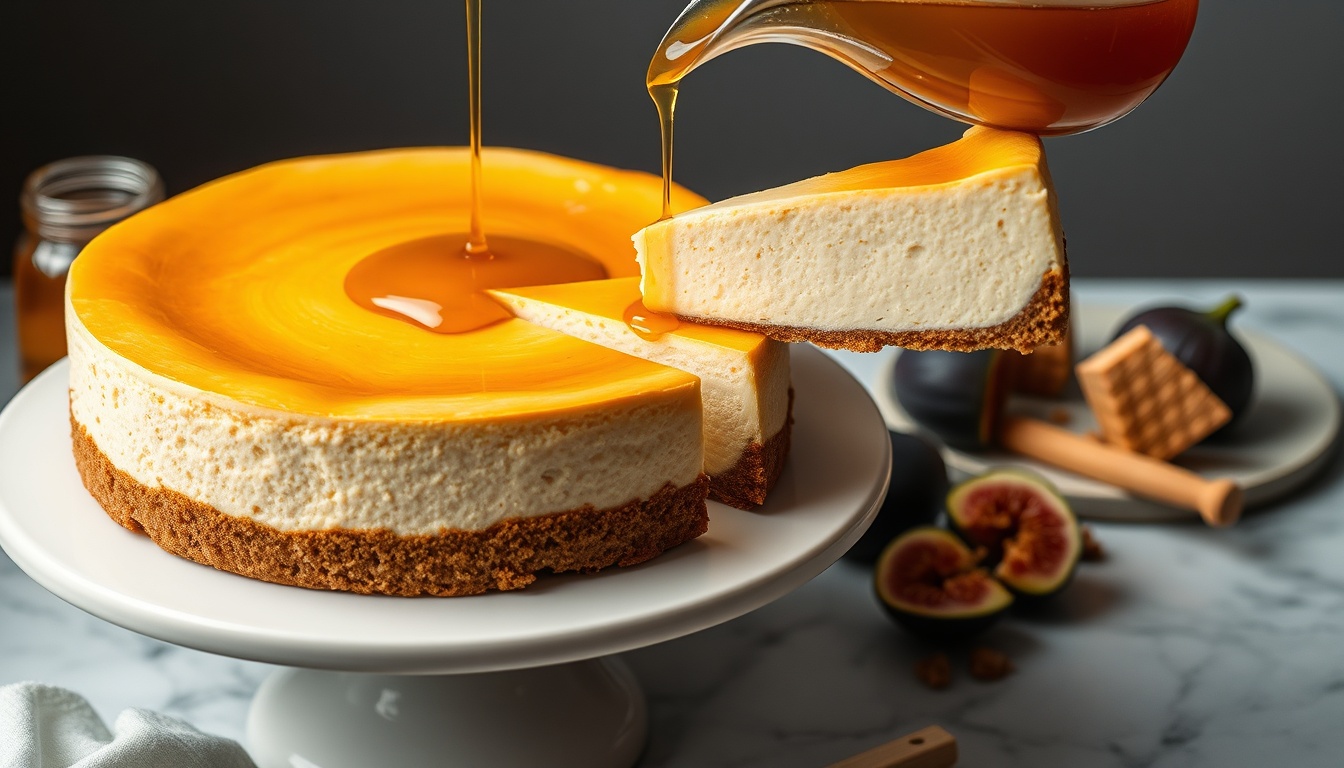
- **Step 5: Slow-cool in the oven** — Turn off the oven, crack the door open about 2 inches, and let the cheesecake cool inside for 1 hour. This gradual cooling prevents the thermal shock that causes cracks. Then remove from water bath and refrigerate.
- **Step 6: Chill and serve** — Refrigerate uncovered for at least 8 hours or overnight. The filling continues to set as it cools. Run a thin knife around the edge before releasing the springform ring. Slice with a hot, dry knife, wiping between cuts.
Pro Tip
Every ingredient must be at room temperature before you start. Cold cream cheese creates lumps that no amount of beating will fix. Set out cream cheese, eggs, and sour cream at least 2 hours before baking. If you forgot, submerge sealed cream cheese packages in warm water for 15 minutes.
Get the Honey Buyer's Cheat Sheet (free PDF)
16 varieties on one page — color, flavor, best use and what a fair price looks like — from the 304 honeys we track.
Choosing the Best Honey for Cheesecake
Since honey is the primary sweetener, its flavor comes through clearly in every bite. Choose a variety that matches your desired flavor profile.
- **Acacia honey** ($9–16) — The top recommendation. Extremely mild with delicate floral notes that sweeten without competing with the cream cheese. Produces the most "classic" cheesecake flavor with a subtle honey undertone.
- **Clover honey** ($9–15) — Mild and widely available. A reliable all-purpose choice that produces a clean, straightforward honey cheesecake. Best for feeding crowds with varying tastes.
- **Orange blossom honey** ($12–24) — Light citrus notes that add brightness to the rich filling. Particularly excellent with the citrus topping variation below.
- **Lavender honey** ($11–17) — Creates a distinctly French-patisserie character with floral, herbal notes. Best for sophisticated palates and smaller servings, as the flavor is more assertive.
- **Avoid dark honeys** — Buckwheat ($9–23) and other dark honeys have bold, malty flavors that overpower the delicate cream cheese filling. Save them for recipes where their intensity is the star, like honey bread or honey BBQ sauce.
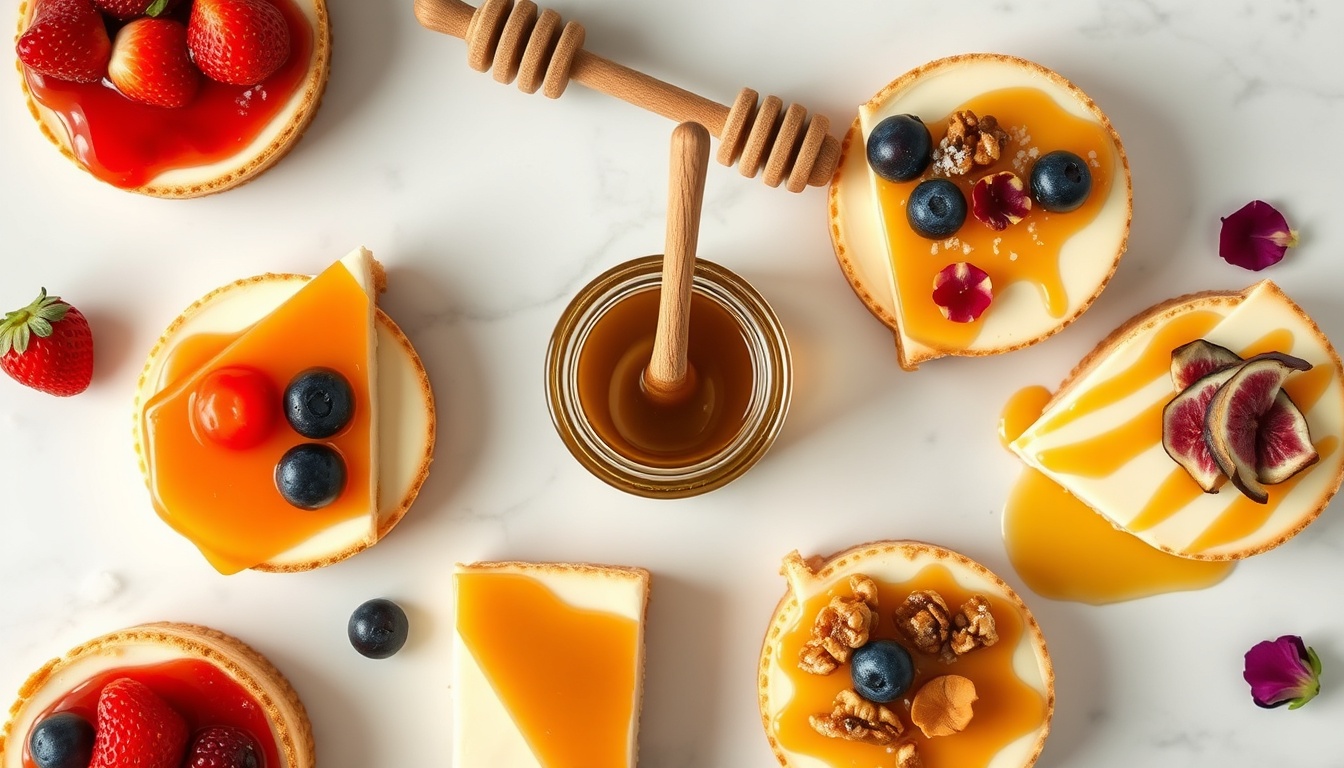
5 Honey Cheesecake Topping Variations
Each topping transforms the base cheesecake into a different dessert. Apply toppings after the cheesecake is fully chilled.
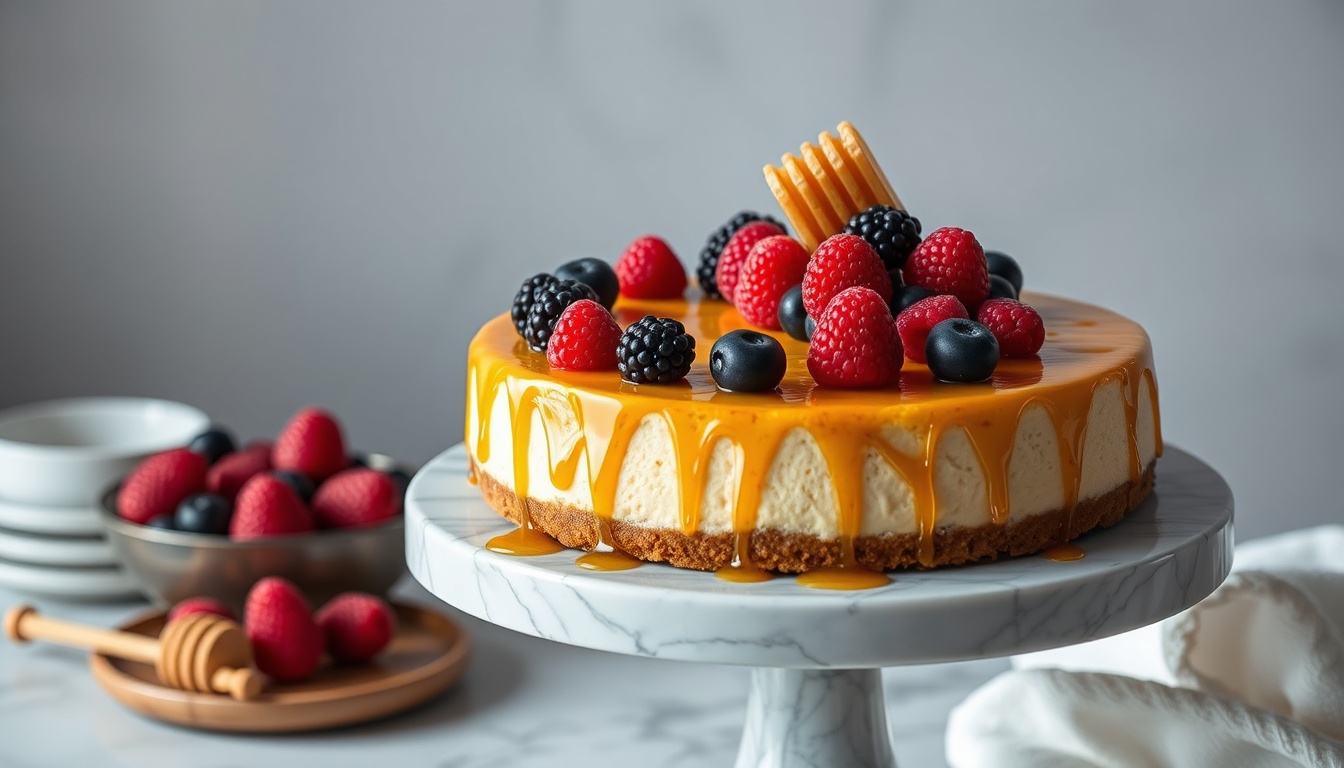
- **1. Honey berry compote** — Simmer 2 cups mixed berries (strawberries, blueberries, raspberries) with 3 tablespoons honey and 1 tablespoon lemon juice for 8-10 minutes until berries burst and sauce thickens slightly. Cool completely before spooning over the cheesecake. The tart berries balance the rich, sweet filling perfectly.
- **2. Honey caramel drizzle** — Heat 1/2 cup honey in a saucepan over medium heat for 5-7 minutes until it darkens to a deep amber (watch carefully — it goes from caramel to burnt quickly). Remove from heat, stir in 3 tablespoons heavy cream and a pinch of flaky sea salt. Drizzle over slices. The honey-based caramel is more complex than sugar caramel.
- **3. Honeycomb and fig** — Top slices with thin fig quarters, crumbled honeycomb, and a drizzle of raw honey. Sprinkle with pistachios. This is the showstopper presentation for dinner parties.
- **4. Honey citrus curd** — Whisk 3 egg yolks, 1/4 cup honey, 1/4 cup lemon juice, and 2 tablespoons butter in a double boiler for 8-10 minutes until thick enough to coat a spoon. Cool completely and spread over the chilled cheesecake. The tangy curd cuts through the richness.
- **5. Roasted honey peaches** — Halve 3 ripe peaches, brush with honey, and roast cut-side down at 400°F for 15 minutes. Slice and arrange over the cheesecake. Best in summer when peaches are at peak sweetness. Nectarines work equally well.
The Science of Crack-Free Cheesecake
Cheesecake cracking is the most common complaint, and it has specific, preventable causes.
Cracks form when the surface of the cheesecake sets and contracts before the interior has finished cooking. Three factors cause this: overbaking (the edges dry out and shrink while the center is still liquid), temperature shock (removing a hot cheesecake from the oven into cool air causes rapid contraction), and overbeating (excess air bubbles expand during baking and collapse during cooling, pulling the surface apart).
The water bath addresses the first two problems. Water cannot exceed 212°F (100°C), so the sides of the cheesecake never get hotter than that — preventing the edges from overbaking while the center catches up. The gradual in-oven cooling with the door cracked eliminates temperature shock.
Honey helps with the third problem. Its viscosity reduces air incorporation during mixing compared to granulated sugar, and its moisture-retaining properties keep the filling supple as it cools. Honey cheesecakes crack less than sugar cheesecakes even without a water bath, though the water bath is still recommended for the best results.
Storage and Make-Ahead Tips
Cheesecake is the ideal make-ahead dessert. It must be refrigerated overnight anyway, and it only improves with time.
- **Refrigerated (5-7 days)** — Cover loosely with plastic wrap (do not press plastic against the surface) or store in a cake carrier. Cheesecake actually tastes best on day 2-3, after the honey and cream cheese flavors have fully melded.
- **Frozen (2-3 months)** — Freeze the whole cheesecake or individual slices wrapped tightly in plastic, then foil. Thaw overnight in the refrigerator. Honey cheesecake freezes better than sugar versions because honey prevents ice crystal formation. Add toppings after thawing.
- **Make-ahead timeline** — Bake 2-3 days before serving. Add any topping the morning of serving. The cheesecake needs at least 8 hours in the fridge to fully set, and overnight is better. Rushing this step produces a soft, sliceable but not firm cheesecake.
- **Slicing tip** — Use a long, thin knife dipped in hot water and wiped dry between each cut. The heat melts through the filling cleanly instead of dragging and smearing. A wire cheese slicer also works well for uniform slices.
Common Mistakes and How to Fix Them
Even experienced bakers run into cheesecake problems. Most issues trace back to temperature or technique.
- **Cheesecake cracked on top** — Overbaked, cooled too fast, or batter was overbeaten. Next time, pull from the oven when the center still has a 3-inch wobble zone, and always slow-cool in the oven with the door cracked.
- **Filling is lumpy** — Cream cheese was not at room temperature. Once lumps form, they are nearly impossible to smooth out. For rescue: press the batter through a fine-mesh strainer before pouring into the crust.
- **Crust is soggy** — The crust was not pre-baked, or the cheesecake was not refrigerated long enough. Pre-bake the crust for 10 minutes before adding filling, and refrigerate the finished cheesecake for a full 8 hours.
- **Cheesecake sank in the middle** — Overbaking causes the edges to puff up, then the whole cake deflates as it cools. The center should still jiggle when you remove it from the oven. Minor sinking is normal and invisible once topped.
- **Water leaked into the springform pan** — The foil wrapping had gaps. Use two layers of heavy-duty foil and press it tightly around the pan. Alternatively, place the springform pan inside a slightly larger cake pan or oven bag before wrapping.