Why Honey Makes Roasted Carrots Better
Carrots already contain natural sugars that caramelize during roasting. Adding raw honey amplifies this natural sweetness while introducing a layer of floral complexity that plain sugar or maple syrup cannot match. The result is a side dish that tastes far more sophisticated than its simple ingredient list suggests.
The science behind honey-roasted carrots comes down to two reactions. First, honey's fructose and glucose caramelize at lower temperatures than sucrose, meaning you get golden edges faster without drying out the interior. Second, honey's amino acid traces participate in the Maillard reaction alongside the carrots' own compounds, creating deeper flavor compounds than either ingredient alone.
This recipe takes 30 minutes — 5 minutes prep, 25 minutes roasting — and produces carrots that work as a weeknight side dish or a holiday table centerpiece.
Best Honey Varieties for Roasted Carrots
The honey you choose noticeably affects the final flavor. Each variety pairs differently with the earthy sweetness of roasted carrots.
- **Wildflower honey** — Best all-around choice. Complex, multi-floral sweetness that complements without overpowering. Works with every variation below.
- **Clover honey** — Clean, neutral sweetness that lets the carrot flavor shine. Good for the classic version when you want simplicity.
- **Orange blossom honey** — Subtle citrus notes that make roasted carrots taste bright and elegant. Excellent for the lemon-herb and ginger-citrus variations.
- **Buckwheat honey** — Bold, molasses-like depth that creates an almost barbecue-like roasted carrot. Best paired with the harissa or cumin-coriander variations.
- **Lavender honey** — Subtle floral notes that create the most elegant version. Pairs beautifully with the thyme variation and goat cheese garnish.
Pro Tip
Avoid manuka honey here — its earthy flavor competes with the carrots. Save manuka for eating straight, where its character justifies the price (manuka guide).
Get the Honey Buyer's Cheat Sheet (free PDF)
16 varieties on one page — color, flavor, best use and what a fair price looks like — from the 304 honeys we track.
The Complete Recipe: Honey Roasted Carrots
This recipe serves 4-6 as a side dish. Total time: 30 minutes.
Ingredients
- 2 lbs carrots (about 12 medium), peeled
- 3 tablespoons raw honey
- 2 tablespoons extra-virgin olive oil
- 3/4 teaspoon fine sea salt
- 1/4 teaspoon freshly ground black pepper
- Fresh thyme leaves for garnish (optional)
- Flaky sea salt for finishing (optional)
Step-by-Step Instructions
**Step 1: Prep and preheat.** Preheat oven to 425°F (220°C). Line a large rimmed baking sheet with parchment paper. Cut carrots on a diagonal into 2-inch pieces. If using whole young carrots, halve lengthwise. The diagonal cut maximizes surface area for caramelization.
**Step 2: Toss with honey and oil.** In a large bowl, whisk together honey, olive oil, salt, and pepper until emulsified. Add carrots and toss until every piece is evenly coated. This step matters — uncoated carrots will dry out while over-coated ones will burn.
**Step 3: Arrange for maximum caramelization.** Spread carrots on the prepared baking sheet in a single layer with space between each piece. Flat-cut sides should face down for maximum contact with the hot pan. Crowding causes steaming instead of roasting.
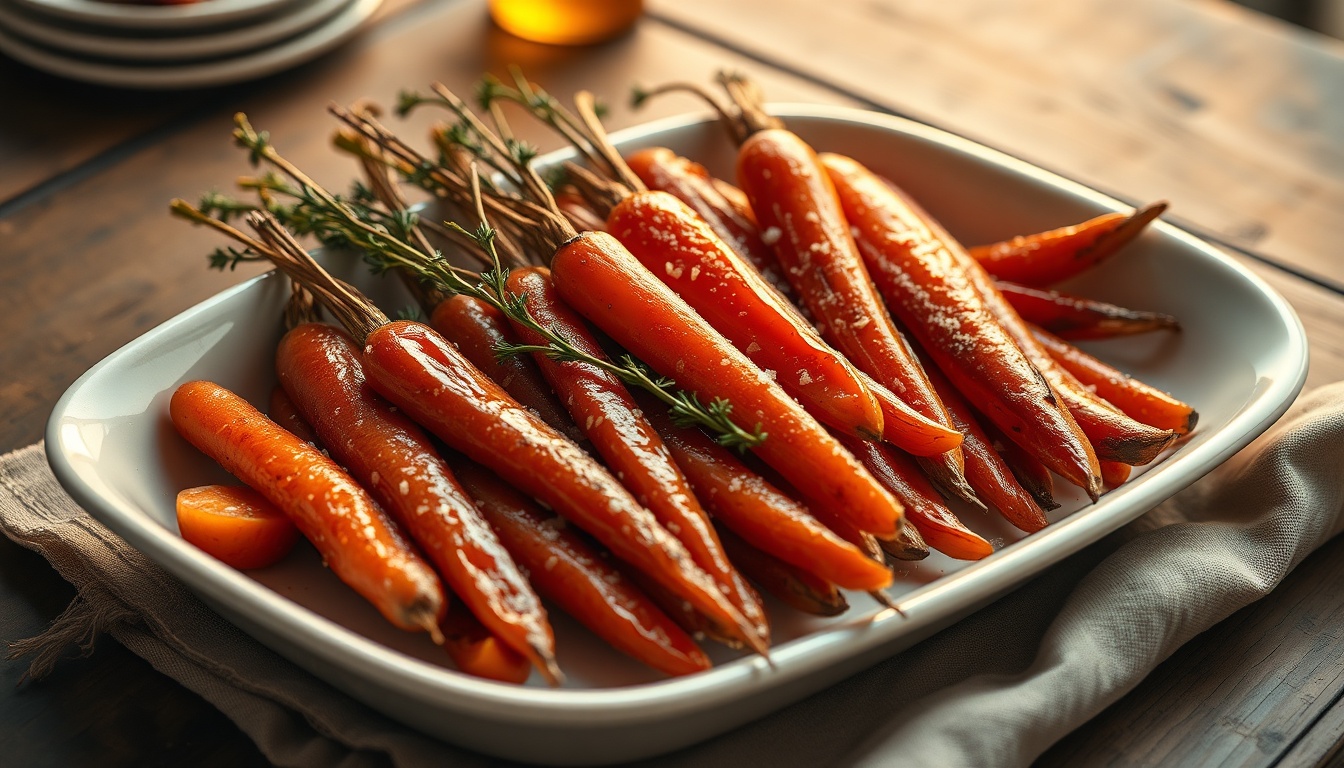
**Step 4: Roast.** Place on the middle rack and roast 20-25 minutes, flipping once at the 15-minute mark. Carrots are done when they're tender when pierced with a fork, with golden-brown edges and a glossy honey glaze.
**Step 5: Finish and serve.** Remove from oven and let rest on the pan for 2 minutes — the honey glaze continues to set. Transfer to a serving dish, sprinkle with fresh thyme and flaky sea salt, and serve warm.
Pro Tip
The 425°F temperature is the sweet spot. Lower and you get soft, pale carrots without caramelization. Higher and the honey burns before the carrots cook through.
6 Flavor Variations
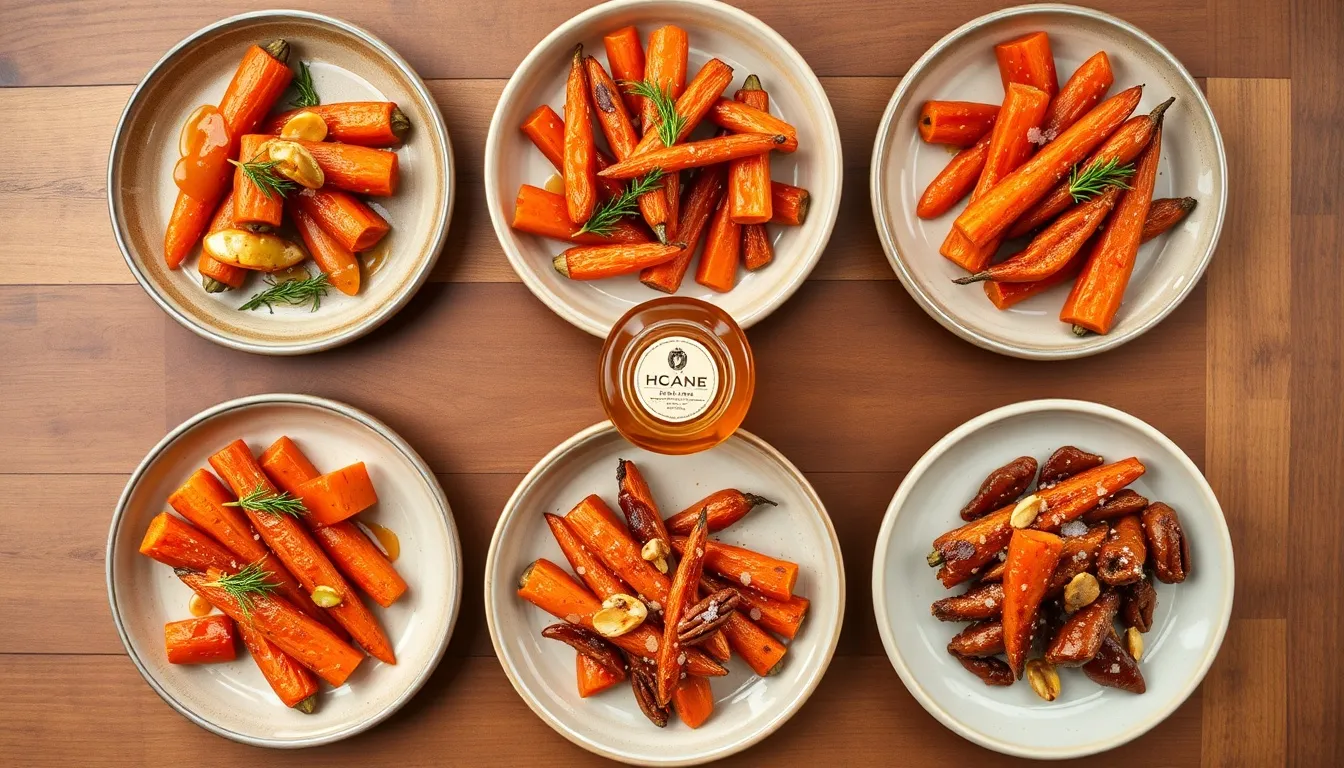
The base recipe is intentionally simple. These variations add one flavor dimension at a time without overcomplicating the dish.
- **Maple-Thyme:** Replace 1 tablespoon honey with maple syrup and add 1 tablespoon fresh thyme leaves before roasting. The maple-honey blend creates deeper caramelization.
- **Harissa-Spiced:** Add 1 tablespoon harissa paste to the honey-oil mixture. Use buckwheat honey for maximum depth. Garnish with chopped pistachios and fresh mint.
- **Ginger-Citrus:** Add 1 tablespoon fresh grated ginger and the zest of one orange to the honey mixture. Use orange blossom honey and finish with a squeeze of fresh orange juice after roasting.
- **Cumin-Coriander:** Add 1 teaspoon ground cumin and 1/2 teaspoon ground coriander to the honey mixture. Finish with a drizzle of tahini and chopped cilantro.
- **Balsamic:** Replace 1 tablespoon honey with balsamic vinegar. The acid-sweet combination creates a deeply savory glaze. Finish with shaved Parmesan and fresh basil.
- **Hot Honey:** Replace regular honey with homemade hot honey for a sweet-spicy kick. Finish with crumbled goat cheese to balance the heat.
Carrot Selection and Prep Tips
- **Size matters.** Choose medium carrots (about 1 inch diameter). Thin carrots overcook and burn, while jumbo carrots stay raw in the center while the edges char.
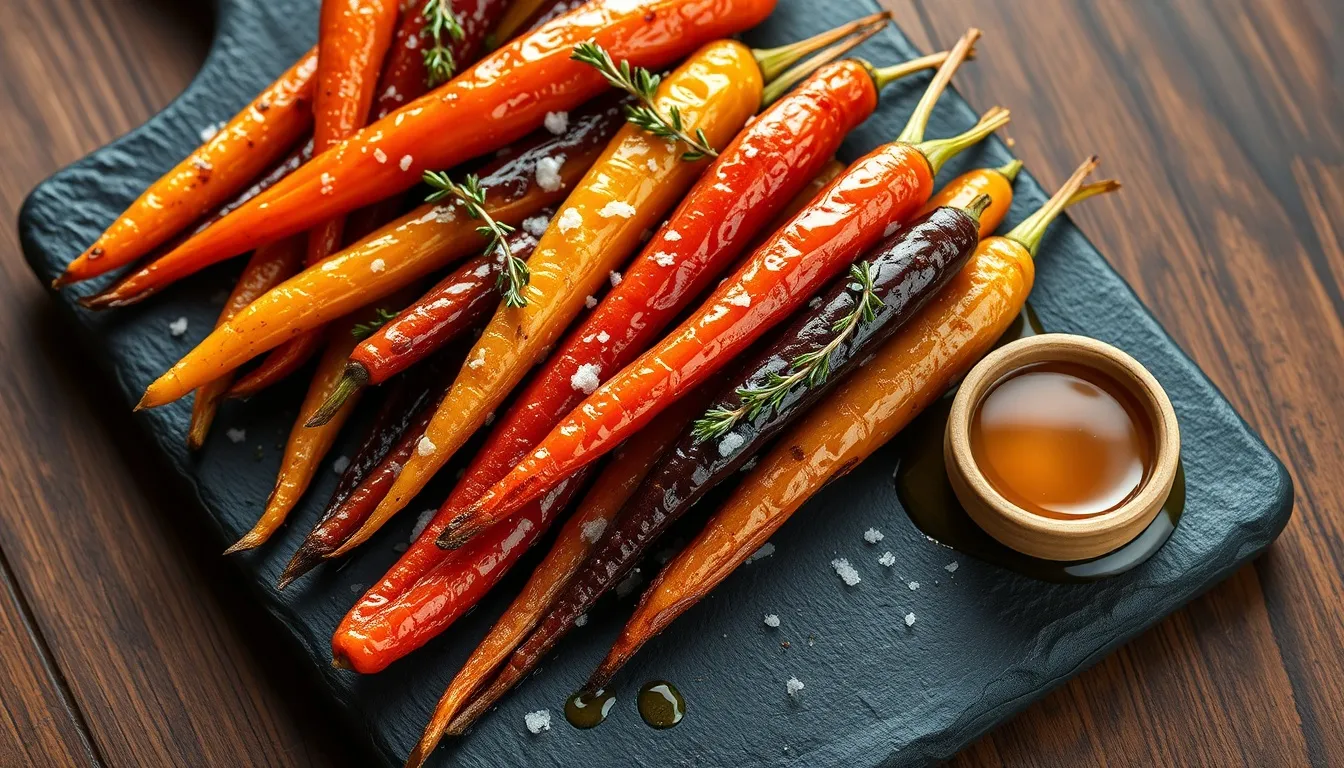
- **Rainbow carrots.** Purple, yellow, white, and orange carrots all roast beautifully and make a stunning presentation. Purple carrots may bleed color slightly — keep them in their own section on the pan.
- **Baby carrots.** Pre-cut baby carrots work in a pinch but won't caramelize as well — their rounded surfaces have less flat contact area with the pan. If using, halve them lengthwise.
- **Whole young carrots.** Farmers market young carrots with tops attached are ideal. Trim tops to 1 inch (the greens can be used in pesto or chimichurri), scrub instead of peeling, and halve lengthwise.
- **Even sizes.** The most important prep tip: cut all pieces to similar thickness so they cook at the same rate. Thinner ends should be slightly larger pieces, and thick ends should be smaller.
Serving Suggestions
Honey roasted carrots pair with almost any protein or grain. Here are the best combinations.
- **Roasted chicken** — The classic pairing. Roast carrots on the same pan alongside chicken thighs for easy one-pan cleanup.
- **Honey garlic chicken** — The honey in both dishes creates a cohesive meal with a sweet-savory theme. Use wildflower honey in both for complex flavor harmony.
- **Honey glazed salmon** — A lighter pairing that makes an elegant dinner plate. Orange blossom honey works beautifully with both the salmon and carrots for citrus-floral harmony.
- **Grain bowls** — Serve over farro, quinoa, or rice with goat cheese, arugula, and a drizzle of honey and olive oil dressing. Acacia honey creates the most delicate dressing that won't overpower grain bowl ingredients.
- **Holiday meals** — Honey roasted carrots with the balsamic or ginger-citrus variation are beautiful on Thanksgiving, Christmas, or Easter tables.
- **Mezze platter** — Serve the cumin-coriander variation alongside hummus, warm pita, and labneh for a Middle Eastern-inspired spread.
Make-Ahead and Storage
**Prep ahead:** Cut and coat carrots with the honey mixture up to 4 hours in advance. Refrigerate on the baking sheet, covered. Let sit at room temperature 10 minutes before roasting.
**Storage:** Refrigerate leftover roasted carrots for up to 4 days. The honey glaze acts as a natural preservative, keeping them flavorful longer than plain roasted vegetables.
**Reheating:** Reheat in a 375°F oven for 8-10 minutes to re-crisp the edges. Avoid microwaving — it makes roasted vegetables soggy. Alternatively, reheat in a hot skillet with a splash of olive oil for 3-4 minutes.
**Meal prep use:** Cold honey roasted carrots are surprisingly good in grain bowls, on salads, or as a snack straight from the fridge.
The Nutrition Advantage of Honey-Roasted Carrots
Carrots are one of the most nutrient-dense vegetables per calorie: a single cup provides 428% of the daily value for vitamin A (as beta-carotene), 21% vitamin K, 12% potassium, and meaningful amounts of fiber, vitamin C, and B6. The bright orange color signals high carotenoid content.
Interestingly, roasting improves carrot nutrition. Heat breaks down cell walls, making beta-carotene up to 6 times more bioavailable than in raw carrots. The olive oil in this recipe further enhances absorption since carotenoids are fat-soluble — you absorb significantly more vitamin A when carrots are cooked with fat than when eaten raw and dry.
The raw honey adds about 1.5 teaspoons per serving (roughly 30 calories), and a floral note. Clover honey keeps the flavor clean, wildflower honey adds complexity from diverse nectar sources, and buckwheat honey brings a dark, malty depth. Compare that to many commercial glazed carrot recipes that use 2-3 tablespoons of brown sugar or maple syrup per serving. Honey's higher sweetening power means you need less (see honey vs sugar).