Honey vs Coconut Sugar: A Science-Based Comparison
Coconut sugar has exploded in popularity as a "healthier" sweetener alternative, often placed alongside honey as a natural option. Both are marketed as better-for-you alternatives to refined white sugar — but how do they actually compare?
The answer is more nuanced than most health blogs suggest. Honey and coconut sugar differ substantially in their composition, how they're made, their effects on blood sugar, and the health benefits they provide. This guide examines the evidence behind each sweetener so you can make an informed choice for your specific health goals.
For context on how honey compares to other sweeteners, see our guides on honey vs sugar, honey vs maple syrup, honey vs agave, and honey vs stevia.
How They're Made: Fundamentally Different Origins
Understanding how each sweetener is produced reveals why they differ so significantly:
**Honey** — Produced by honey bees (*Apis mellifera*) from flower nectar through an enzymatic process. Bees collect nectar, add enzymes (glucose oxidase, invertase, diastase), reduce water content through evaporation, and cap the finished honey in beeswax cells. Raw honey retains all enzymes, polyphenols, prebiotics, and antimicrobial compounds. No human processing is required beyond extraction from the comb. Learn more in our guide on how bees make honey.
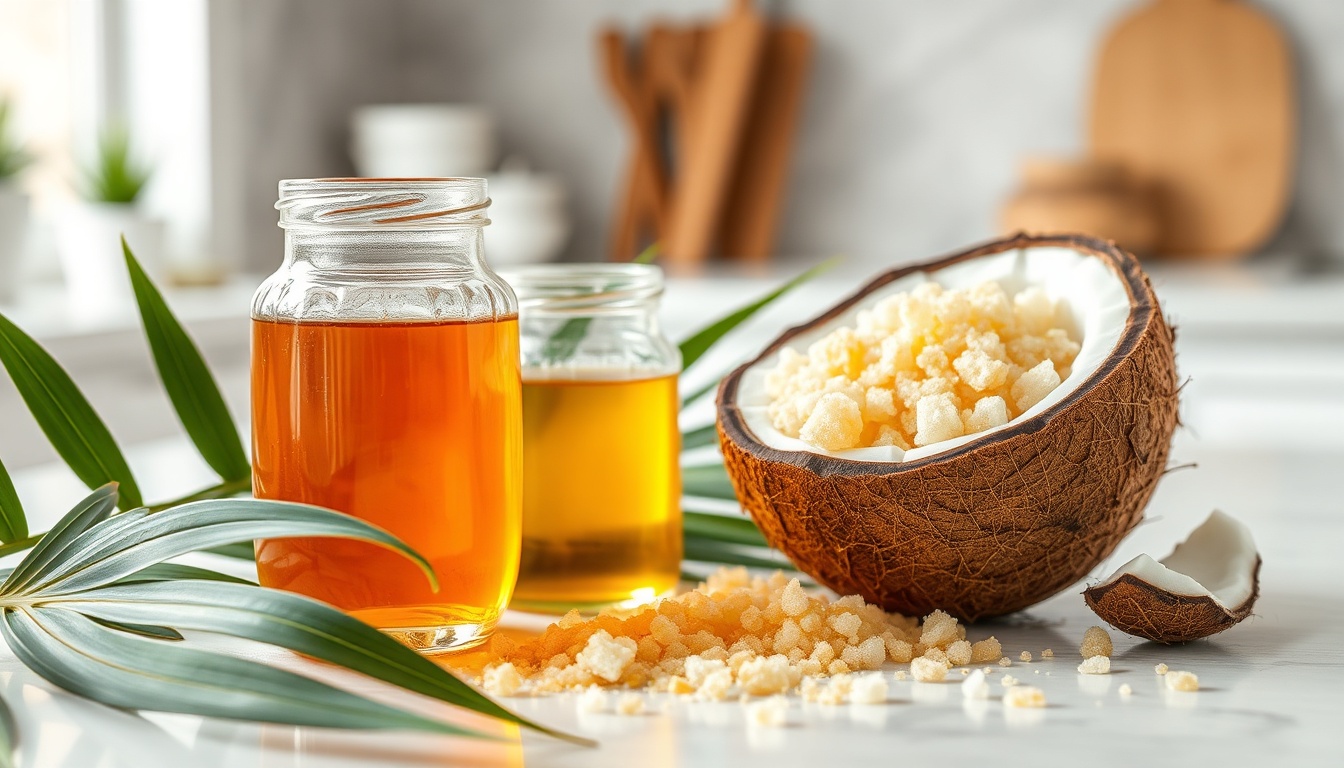
**Coconut sugar** — Produced from the sap of coconut palm flower buds (*Cocos nucifera*). The sap is collected by tapping the flower stalks, then heated to evaporate moisture until it crystallizes into granules. This involves boiling at high temperatures (100-120°C) for several hours. Some producers add small amounts of sulfite as a preservative. The end product is a dry, granulated sugar that looks and behaves like brown sugar.
**Key difference** — Honey is a biologically active food created by an enzymatic process at hive temperature (35°C), preserving living enzymes and heat-sensitive compounds. Coconut sugar is produced through high-heat evaporation that degrades most heat-sensitive nutrients in the original sap. This processing distinction has significant implications for the final nutritional profile.
Get the Honey Buyer's Cheat Sheet (free PDF)
16 varieties on one page — color, flavor, best use and what a fair price looks like — from the 268 honeys we track.
Nutritional Comparison: Per Tablespoon
Here's how the two sweeteners compare nutritionally per tablespoon serving:
**Calories** — Honey: 64 calories | Coconut sugar: 45 calories. Coconut sugar is less calorie-dense because it contains less sugar per tablespoon (it's a dry granule vs a dense liquid). However, gram-for-gram, they're closer: honey has 3.04 kcal/g vs coconut sugar's 3.75 kcal/g — coconut sugar is actually more calorie-dense by weight.
**Sugar composition** — Honey: ~82% sugars (38% fructose, 31% glucose, 7% maltose, 1.5% sucrose, plus 25+ other sugars). Coconut sugar: ~75% sugars (predominantly sucrose at 70-80%, with small amounts of glucose and fructose). This is a fundamental difference: honey provides pre-digested monosaccharides while coconut sugar delivers mostly sucrose that must be broken down.
**Minerals** — Coconut sugar contains moderate amounts of potassium (25 mg/tbsp), iron (0.2 mg, ~1% DV), zinc (0.1 mg), and calcium (4 mg). Honey contains smaller amounts of potassium (11 mg/tbsp), iron, zinc, and calcium. Coconut sugar has a mineral advantage, though both provide only trace amounts relative to daily needs.
**Antioxidants and polyphenols** — Honey contains 30+ identified polyphenols (quercetin, chrysin, pinocembrin, caffeic acid, etc.) with documented biological activity including NF-κB pathway inhibition. Coconut sugar contains polyphenols from the original sap (particularly flavonoids and tannins), but many are degraded during the high-temperature processing. A 2014 study in the *Journal of Functional Foods* found that raw coconut sap had significant antioxidant activity, but this decreased by 30-50% after processing into coconut sugar.
**Enzymes** — Honey contains active enzymes (glucose oxidase, diastase, invertase, catalase) that drive its antibacterial properties and continue working after consumption. Coconut sugar contains no active enzymes — they're destroyed during boiling.
**Prebiotics** — Honey contains fructo-oligosaccharides (FOS) and galacto-oligosaccharides (GOS) that feed beneficial gut bacteria. Coconut sugar contains inulin — also a prebiotic fiber — with estimates of 1-2% inulin content. However, the inulin content varies significantly between products, and some analyses have found negligible amounts in commercial coconut sugar.
For a complete breakdown of honey's nutritional profile, see our guide on honey nutrition facts.
Pro Tip
The inulin content of coconut sugar is frequently overstated in marketing. A widely cited figure of "~2% inulin" comes from a single Philippine government report. Independent analyses have found much lower or variable inulin levels in commercial products, particularly those that undergo extensive heating.
Carbohydrate and Label Comparison
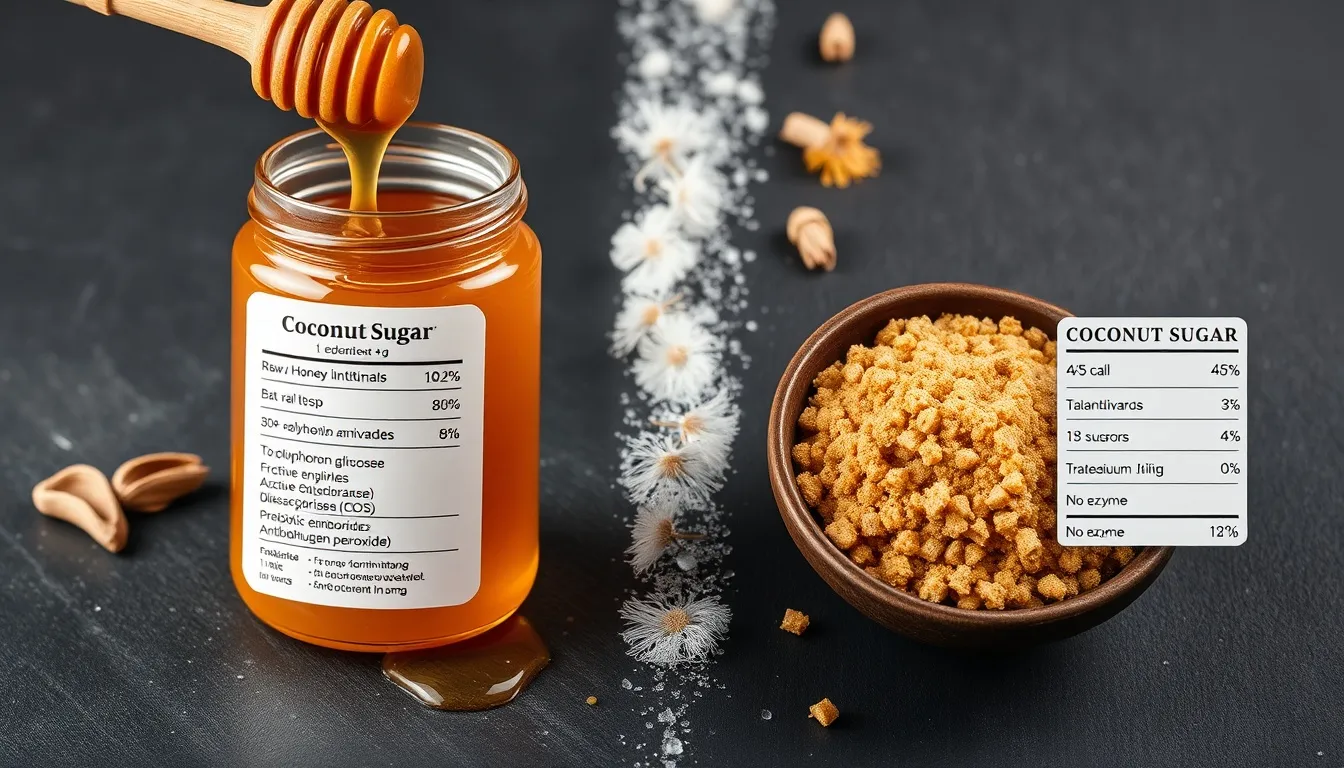
Honey and coconut sugar are both caloric sweeteners that contribute carbohydrate and added sugar. Marketing terms, processing differences and trace minerals do not make either one a diabetes treatment.
Compare equal recipe servings using each product's Nutrition Facts panel. The honey carbohydrate and label guide explains serving-size total-carbohydrate counting and why neither sweetener is medically preferred for everyone.
For baking, coconut sugar behaves like a dry granulated sugar while honey adds liquid. Account for that recipe difference separately from the nutrition comparison.
Health Benefits Comparison
This is where the two sweeteners diverge most significantly:
Where Honey Wins
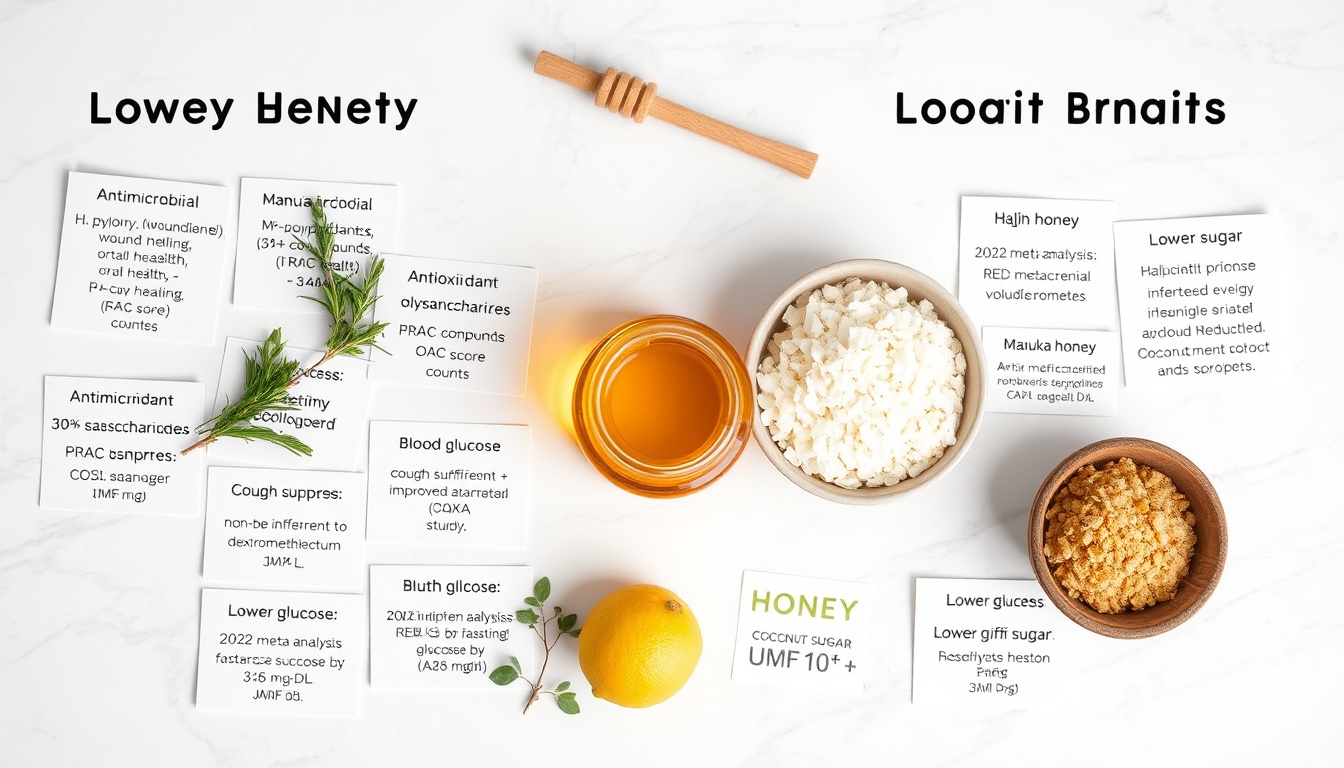
**Antibacterial and antimicrobial properties** — Honey is effective against 60+ bacterial species including MRSA, driven by enzymatic H₂O₂ generation, low pH, osmotic effects, and (in manuka) methylglyoxal. Coconut sugar has no documented antimicrobial activity. This is not a marginal difference — it's a fundamental biological property that coconut sugar simply does not possess.
**Cough suppression** — The 2020 *BMJ Evidence-Based Medicine* systematic review of 14 studies with 1,761 participants confirmed honey's superiority over usual care for upper respiratory symptoms. No comparable evidence exists for coconut sugar. See our guide on honey for sore throat and cough.
**Wound healing** — The 2015 Cochrane systematic review of 26 RCTs (3,011 participants) established honey as an effective wound treatment. FDA-cleared medical honey products (Medihoney, Activon) are used in hospitals worldwide. Coconut sugar has no wound-healing evidence or applications. See our guide on honey wound healing.
**Prebiotic gut health** — Honey's FOS and GOS have strong evidence for selectively promoting beneficial gut bacteria (Bifidobacterium, Lactobacillus) and inhibiting pathogens. While coconut sugar may contain some inulin, the amounts are inconsistent and the prebiotic evidence is far weaker. See our guide on honey and gut health.
**Anti-inflammatory effects** — The 2022 *Nutrition Reviews* meta-analysis of 18 RCTs confirmed honey reduces CRP and inflammatory markers through NF-κB pathway inhibition. No comparable clinical trial evidence exists for coconut sugar.
**Cardiovascular benefits** — The same meta-analysis found honey improved total cholesterol, LDL, triglycerides, and fasting blood glucose compared to sugar controls. Coconut sugar has no RCT evidence for cardiovascular outcomes.
Where Coconut Sugar Wins
**Mineral density** — Coconut sugar provides more iron, potassium, zinc, and calcium per serving than honey. For individuals seeking to maximize mineral intake from sweeteners, coconut sugar has an edge — though both provide only small fractions of daily needs.
**Baking convenience** — Coconut sugar is a dry granule that can substitute 1:1 for white or brown sugar in virtually any baked goods recipe without adjusting liquids, temperature, or leavening. Honey requires a more complex substitution (2/3 cup per cup of sugar, reduce liquids, add baking soda, lower temperature). See our honey baking substitution guide.
**Lower calories per tablespoon** — At 45 vs 64 calories per tablespoon, coconut sugar has a caloric advantage by volume. However, this is largely because coconut sugar is less dense than liquid honey. By weight, coconut sugar is actually slightly more caloric.
**Vegan status** — Coconut sugar is always vegan. Honey is an animal product, which matters for those following a strict vegan diet. See our guide on is honey vegan.
Where They Tie
**Antioxidant content** — Both provide meaningful antioxidant compounds, though different types. Honey's polyphenol profile is better studied and documented, while coconut sugar's antioxidant capacity is reduced by processing.
**Blood sugar impact at moderate intake** — At typical daily amounts, both have acceptable glycemic loads. The practical difference in blood sugar response is small when consumed with meals.
**Not a health food** — Neither should be consumed in large quantities for health benefits. Both are caloric sweeteners that happen to offer more nutritional value than refined sugar. The benefits come from replacing worse sweeteners, not from adding more of either.
Environmental and Ethical Considerations
Beyond personal health, the environmental impact of each sweetener differs:
**Honey production** — Beekeeping supports pollinator populations that are essential for food production (one-third of food crops depend on bee pollination). Buying honey from responsible beekeepers directly supports pollinator health. However, concerns exist about managed honey bees competing with native pollinators. See our bee-friendly gardening guide for more context.
**Coconut sugar production** — Coconut palms that are tapped for sugar sap produce significantly fewer coconuts (coconut yield drops by 50-75% when the flower is tapped for sap). In regions where coconut is a dietary staple (Philippines, Indonesia, Sri Lanka), diverting palms to sugar production can affect local food security. On the positive side, coconut palms grow on marginal land, require minimal inputs, and provide income to smallholder farmers.
**Processing footprint** — Raw honey requires minimal processing (extraction, straining). Coconut sugar requires hours of fuel-intensive boiling to evaporate sap. In traditional production, this often means burning wood or coconut husks.
**Neither is environmentally perfect** — Both have trade-offs. Local honey from ethical beekeepers and fair-trade coconut sugar from sustainable producers are the best choices for minimizing environmental impact.
Common Myths Debunked
Several claims about both sweeteners need correction:
- **"Coconut sugar has a GI of 35"** — This widely repeated figure comes from a single industry-funded study with 10 subjects. Independent testing consistently measures GI at 54-68. While lower than table sugar (65), it's not the dramatically low-GI sweetener often claimed.
- **"Coconut sugar is rich in inulin/fiber"** — The often-cited "2% inulin" figure is not consistently found in commercial products. Most of the inulin in raw coconut sap is degraded or reduced during high-temperature processing.
- **"Honey is just sugar"** — A 2022 meta-analysis of 18 RCTs showed honey produces measurably different clinical outcomes than sugar (better cholesterol, lower inflammation, improved blood glucose). Honey's 30+ polyphenols, active enzymes, and prebiotics make it biochemically distinct from any simple sugar.
- **"Coconut sugar is unprocessed"** — Coconut sugar requires hours of boiling at 100-120°C to crystallize sap into granules. This is significant processing that degrades heat-sensitive compounds. It's less processed than white sugar (no chemical refining or bleaching) but not "unprocessed."
- **"One is dramatically healthier than the other"** — At typical consumption levels, both are reasonable sweetener choices that are modestly better than refined sugar. The differences matter more at higher consumption or for specific health conditions.
- **"Coconut sugar tastes like coconut"** — Despite the name, coconut sugar has a brown sugar/caramel flavor, not a coconut flavor. The sap is from the flower, not the coconut fruit.
Which Should You Choose? A Decision Framework
Your optimal choice depends on your specific priorities:
**Choose honey if:** You want antimicrobial benefits, cough/cold support, wound healing properties, or prebiotic gut health support. You prefer a sweetener with extensive clinical trial evidence for health outcomes. You use sweeteners primarily in beverages, dressings, marinades, or as a topping. You want to support pollinator health.
**Choose coconut sugar if:** You need a 1:1 drop-in replacement for brown or white sugar in baking. You follow a vegan diet. You prefer a granulated sweetener for dry applications (rubs, sprinkles, mixed into oatmeal). You want slightly higher mineral content per serving.
**Consider both if:** You cook and bake regularly — coconut sugar for baking, honey for beverages, dressings, and medicinal uses. Using each where it performs best gives you the broadest nutritional and functional benefits.
For carbohydrate planning, compare the actual serving and product label; culinary preferences do not establish a diabetes recommendation.
**For weight management** — Neither is a weight loss food. Both should be used in moderation as part of a calorie-appropriate diet. See our guide on honey for weight loss.
For a complete picture of how honey compares across all major sweeteners, explore our honey vs sugar, honey vs maple syrup, and honey vs agave comparisons.
Sweetener next steps
Diabetes note — Neither honey nor the compared sweetener is medically preferred. Compare exact serving-size total carbohydrate and added sugars with the honey carbohydrate and label guide, then follow an individualized care plan.