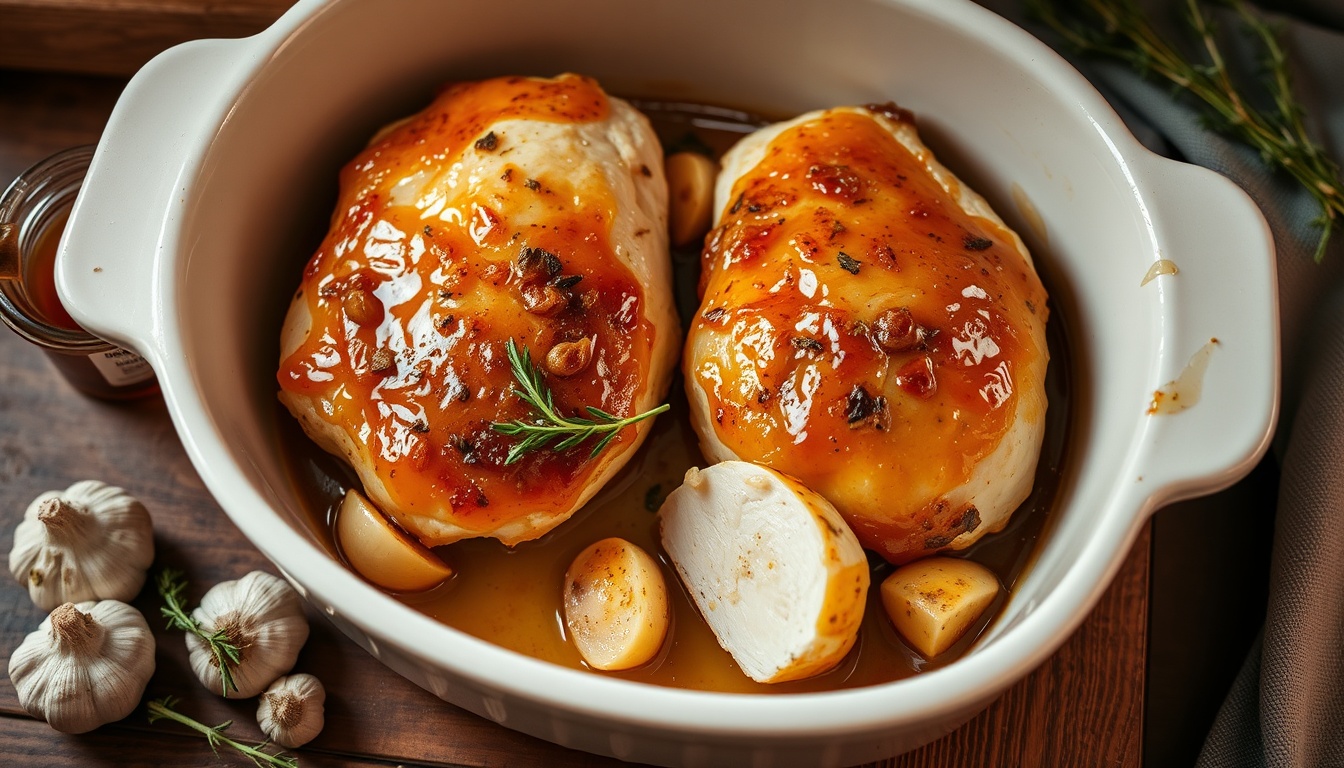
The Base Recipe
Honey mustard chicken needs enough mustard to keep the glaze tangy, with honey added for sweetness and a sticky finish. Reserve the finishing portion before the sauce touches raw chicken.
For a clear edible-weight basis, this version uses 900 g of boneless, skin-on thigh meat weighed after bone removal. Do not weigh a bone-in package and enter the same number as edible meat.
Recipe
Baked Honey Mustard Chicken
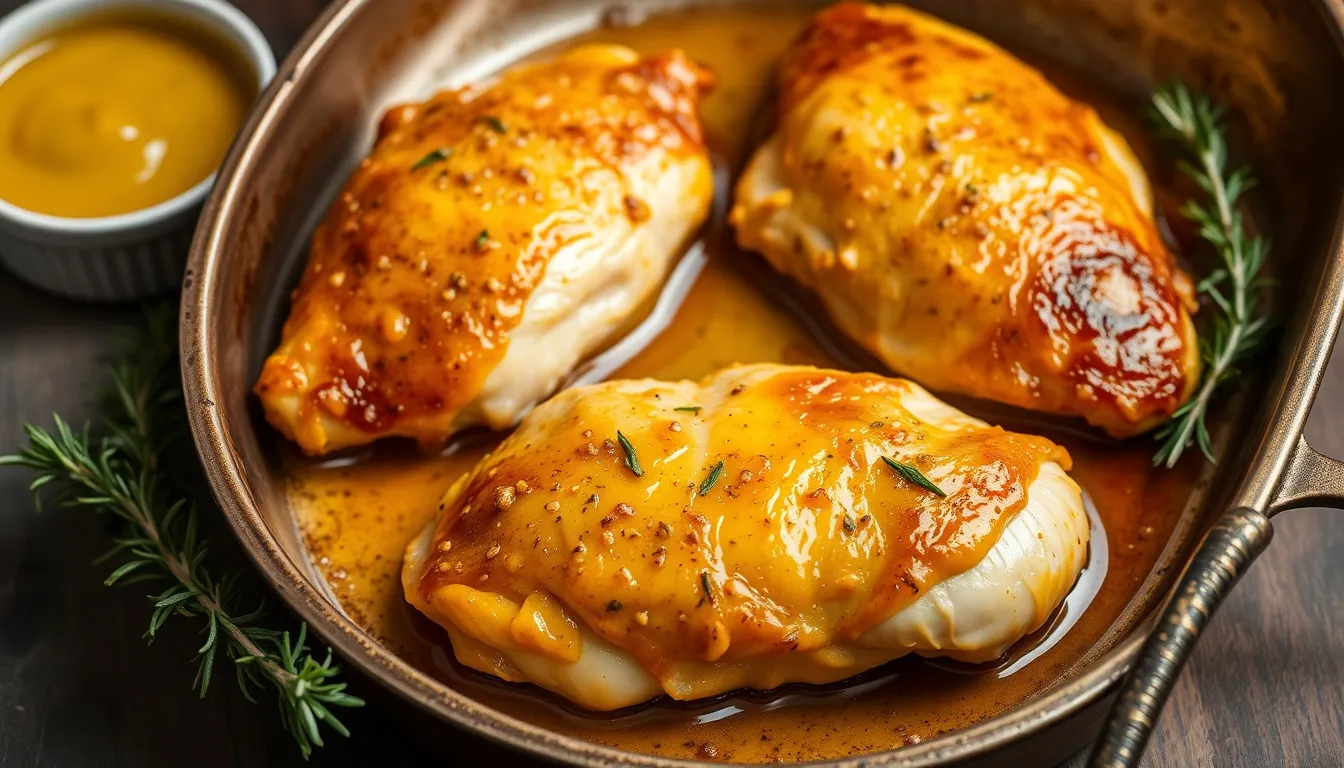
Bake boneless skin-on thigh meat with honey, Dijon mustard and garlic. Includes five variations, clean reserved glaze for basting and a measured ingredient estimate.
9Ingredients
Yield: 4 servings
- 900 g raw chicken thigh meat and skin
- 1/3 cup clover honey
- 5 tablespoons WinCo Foods Dijon mustard
- 3 cloves garlic, minced
- 1 tablespoon olive oil
- 1 tablespoon cider vinegar
- 1/2 teaspoon paprika
- 1/2 teaspoon salt
- 1/4 teaspoon black pepper, ground
Ingredient amounts scale; instructions show the original batch. Cooking times and pan sizes may need adjustment. Season to taste. Honey grams use US measures at 20°C and 17.5% moisture, a density estimate; weigh your honey for precision.
Instructions
- 1Heat the oven and mix glazeHeat the oven to 400°F (200°C). Whisk honey, Dijon mustard, garlic, olive oil, cider vinegar, paprika, salt and pepper. Put three tablespoons into a separate clean bowl for finishing.
- 2Arrange the chickenPat the boneless, skin-on thighs dry. Place skin-side up in a shallow baking dish with space between them. Brush with the larger portion of glaze.
- 3Bake to the endpointBake for about 25-30 minutes, checking the thickest pieces for at least 165°F (74°C). Larger or thicker thighs need longer. Spoon a little glaze over the exposed meat if it dries out.
- 4Finish the surfaceBrush with the reserved clean glaze. If more browning is wanted, use a broiler-safe pan and broil for 1-2 minutes while watching closely. Skip this step if the glaze is already dark.
- 5Rest and serveRest for 5 minutes before serving. The 50-minute estimate allows preparation, baking, a short broiler finish and resting; it is not a measured cooking guarantee for every thigh size.
Estimated nutrition per serving
637.02 calories · 40.78 g fat · 24.87 g carbohydrate · 37.41 g protein · 925.24 mg sodium
Serving: 1 of 4 servings
Calculated from ingredient weights and USDA FoodData Central: 172385, 169640, 2029577, 169230, 171413, 173469, 171329, 173468, 170931. Estimates use ingredient input weights; actual portions, brands and cooking losses vary. Omitted nutrient values are unavailable, not zero.
Method and Texture
Boneless does not mean skinless. The raw USDA reference here includes edible thigh meat and skin, matching the base ingredient. A skinless breast needs a different reference and may cook faster.
The base uses Dijon mustard. The estimate names a manufacturer-label reference; another brand can differ in salt and other nutrients.
Get the Honey Buyer's Cheat Sheet (free PDF)
16 varieties on one page — color, flavor, best use and what a fair price looks like — from the 304 honeys we track.
5 Flavor Variations
These are separate variations. Their ingredient amounts, cooking times and nutrient totals are not the base recipe calculation.
- Whole-grain: replace 2 tablespoons Dijon with 2 tablespoons whole-grain mustard.
- Lemon-herb: add 1 teaspoon lemon zest and 1 teaspoon chopped fresh thyme.
- Spicy: stir 1 teaspoon hot sauce into the clean finishing portion.
- Maple-honey: replace half the honey with maple syrup.
- Bacon-onion: roast thin onion slices beneath the chicken and finish with separately cooked crumbled bacon; this changes the base estimate.
Choosing the Honey
Clover honey gives a mild base. Wildflower honey adds a fuller floral flavor, while buckwheat honey makes a darker, more assertive glaze. Choose the flavor you want, and see our matching honey guide for other culinary uses.
The chart is an editorial pairing guide on a relative 1-5 flavor scale, not a measured composition or a record of kitchen testing.
1 = mild, 5 = bold. Editorial pairing guidance, not laboratory measurements; jars vary.
- Clover
- Mild base glaze
- Wildflower
- Fuller floral glaze
- Buckwheat
- Bold, dark glaze
Matching a honey to another dish: the honey flavor map
Serving and Leftovers
Divide the base recipe into 4 servings. Rice, noodles, vegetables, herbs, seeds and dipping sauces shown or suggested as accompaniments are optional additions and are not included in the printed ingredient estimate.
Refrigerate cooked chicken promptly at 40°F (4°C) or below in a covered shallow container. Federal guidance gives cooked meat and poultry leftovers 3-4 days. Reheat to 165°F (74°C).
Nutrition Basis
The base ingredient estimate is 637.02 calories per serving (1 of 4 servings). It counts all listed oil and glaze. Optional garnishes, sides and variations are separate. This is an ingredient calculation, not a measured plate or a kitchen-tested yield.
USDA input edible weights divided by yield; no cooking-loss or discarded-food adjustment assumed. USDA provides no usable point estimate for saturated fat, fiber; these nutrients are unknown and omitted, not treated as zero. WINCO FOODS: USDA values normalized from manufacturer labels; label rounding applies. Less-than nutrient declarations are bounds, not point estimates.
Sources
FoodSafety.gov cooking temperatures and cold-storage guidance; ingredient composition from USDA FoodData Central.