Why Honey Garlic Salmon Is a Perfect Weeknight Dinner
The glaze needs only a short finish under the broiler. Bake the salmon first, then watch the surface continuously during the final coloring stage.
Use a foil-lined broiler-safe pan, not parchment under the broiler. The measured base weighs 680 g of edible raw Atlantic farmed salmon, without skin or bones, divided into four similar-thickness fillets.
Recipe
Honey Garlic Salmon
Bake salmon with a honey garlic glaze and finish briefly under the broiler. Includes five variations, a foil-lined pan and a 145°F fish endpoint.
8Ingredients
Yield: 4 servings
- 680 g raw Atlantic farmed salmon, skinless and boneless, four fillets
- 63 g honey (3 tablespoons)
- 32 g soy sauce (2 tablespoons)
- 12 g garlic, minced
- 13.5 g olive oil (1 tablespoon)
- 14.2 g unsalted butter (1 tablespoon)
- 15 g lemon juice (1 tablespoon)
- 1.15 g ground black pepper (1/2 teaspoon)
Ingredient amounts scale; instructions show the original batch. Cooking times and pan sizes may need adjustment. Season to taste. Honey grams use US measures at 20°C and 17.5% moisture, a density estimate; weigh your honey for precision.
Instructions
- 1Prepare a broiler-safe panHeat the oven to 400°F (200°C). Line a broiler-safe rimmed metal pan with foil. Pat the skinless, boneless fillets dry and brush with the measured olive oil. Put them on the foil with space between pieces.
- 2Warm the honey garlic glazeMelt butter in a small saucepan over medium-low heat. Stir in garlic for about 30 seconds, then honey, soy sauce, lemon juice and pepper. Warm until combined. Reserve a clean portion before a brush touches the raw fish.
- 3Bake the filletsBrush with some glaze and bake for about 10–12 minutes, checking the thickest parts sooner if the fillets are thin. Thickness and starting temperature change the cooking time.
- 4Color briefly and check the fishBrush with clean reserved glaze and broil for about 1–3 minutes, watching continuously. Use a thermometer in the thickest part: the salmon must reach at least 145°F (63°C). If the glaze browns before the fish reaches that point, switch back to baking rather than continuing to burn the coating.
- 5Serve four portionsLet stand for about 2 minutes and divide the fillets and edible sauce into four portions. Seeds, fresh herbs and other serving additions are outside the measured base.
Estimated nutrition per serving
467.03 calories · 29.11 g fat · 14.81 g carbohydrate · 35.64 g protein · 541.19 mg sodium
Serving: 1 of 4 servings
Calculated from ingredient weights and USDA FoodData Central: 175167, 169640, 174277, 169230, 171413, 173430, 167747, 170931. Estimates use ingredient input weights; actual portions, brands and cooking losses vary. Omitted nutrient values are unavailable, not zero.
Choose the honey by flavor
Compare the best honey for glazed salmon. Clover honey gives a mild coating; wildflower honey varies with its nectar sources and can taste more floral. Choose one jar for the measured base.
This map is an editorial flavor guide using a relative 1–5 intensity scale. It is not a measured sweetness, quality or nutrition score. The variations below change the ingredients and their estimate.
1 = mild, 5 = bold. Editorial pairing guidance, not laboratory measurements; jars vary.
- Clover
- Garlic and mild savory sauces
- Wildflower
- Roasted vegetables and buttery glazes
- Buckwheat
- Strongly spiced or smoky variations
Matching a honey to another dish: the honey flavor map
Get the Honey Buyer's Cheat Sheet (free PDF)
16 varieties on one page — color, flavor, best use and what a fair price looks like — from the 304 honeys we track.
Choosing the Right Honey
The honey variety shapes the glaze's flavor. Since the broiler concentrates the honey's characteristics, even small differences between varieties become noticeable.
- Wildflower honey — Complex, layered sweetness that complements the rich salmon without overwhelming it. The best all-purpose choice.
- Clover honey — Mild and neutral, letting the garlic and soy take center stage. Clean sweetness that works with every variation below.
- Orange blossom honey — Subtle citrus undertone that brightens the glaze beautifully. Particularly good with the citrus-herb variation.
- Acacia honey — Very delicate and floral. Use when you want the salmon's natural flavor to remain the star.
- Buckwheat honey — Dark and malty with molasses-like depth. Creates an assertive, deeply savory glaze that works well with the miso and teriyaki variations.
Choosing the Right Salmon
Salmon quality matters for this recipe. The short cooking time means the fish's texture and flavor are front and center.
- Skin-on fillets (recommended). The skin protects the bottom of the fillet from direct pan heat, keeping the flesh moist while the top caramelizes under the broiler. After cooking, the skin peels away easily if you don't want to eat it.
- Center-cut fillets. Choose pieces from the thicker center section of the fish, about 1 to 1.5 inches thick. Uniform thickness ensures even cooking — thin tail pieces overcook before thicker sections are done.
- Wild vs. farmed. Both work. Wild salmon (sockeye, coho, king) has a more assertive, lean flavor that stands up well to the sweet glaze. Farmed Atlantic salmon is fattier and more buttery, producing an exceptionally moist result.
- Fresh or thawed. If using frozen salmon, thaw completely in the refrigerator overnight. Cooking from frozen releases excess moisture that prevents the glaze from caramelizing.
5 Flavor Variations
The base honey garlic salmon recipe adapts easily to different cuisines and flavor profiles. All variations use the same bake-then-broil method.
- Honey Garlic Soy-Ginger Salmon: Add 1 tablespoon freshly grated ginger and 1 teaspoon sesame oil to the glaze with wildflower honey for complex multi-floral depth that complements Asian flavors. Garnish with sesame seeds and sliced scallions. Pairs well with honey garlic noodles.
- Honey Garlic Lemon-Herb Salmon: Use orange blossom honey for citrus-forward Mediterranean character. Increase the lemon juice to 2 tablespoons and add 1 teaspoon each of dried oregano and thyme to the glaze. Top with thin lemon slices before baking for a bright, Mediterranean-inspired flavor.
- Spicy Honey Garlic Salmon: Use wildflower honey or buckwheat honey for maximum flavor complexity with heat enhancement. Replace the regular honey with hot honey or add 1-2 teaspoons of sriracha or gochujang to the base glaze. The sweet heat creates an addictive crust that pairs well with cooling cucumber salad.
- Honey Garlic Miso Salmon: Use buckwheat honey for the darkest, most complex umami result. Whisk 1 tablespoon white miso paste into the glaze. The umami from miso deepens the savory dimension without adding a strong miso flavor, perfectly complemented by buckwheat's molasses-like depth.
- Honey Garlic Mustard Salmon: Use clover honey for clean sweetness that balances mustard sharpness without competing. Add 1 tablespoon Dijon mustard to the base glaze. The mustard's sharp tang cuts through the honey sweetness and salmon richness. Similar flavor profile to honey mustard chicken but with fish.
Tips for Perfect Honey Garlic Salmon
Five details ensure well-browned results every time.
- Pat the salmon dry. Just like with steak, surface moisture prevents browning. Two paper towels per fillet eliminates the excess water that would otherwise create steam under the glaze.
- Don't skip the broiler step. Baking alone produces a cooked fillet, but the 2-3 minute broiler blast is what transforms the honey glaze from a coating into a caramelized, lacquered crust. It's the difference between good and memorable.
- Use a thermometer. Salmon is perfectly done at 145°F (USDA recommendation) but many prefer it slightly less done at 125-130°F for a silkier texture. Either way, a quick-read thermometer removes the guesswork.
- Glaze twice. Brushing the salmon before baking builds a flavor base. The second coat before broiling creates the glossy, caramelized finish. Wildflower and clover honey caramelize evenly, while buckwheat honey develops color faster due to higher mineral content. Single-glazing produces a thinner, less impressive result.
- Choose the right thickness. Fillets between 1 and 1.5 inches thick work best with this method. Thinner pieces overcook before the glaze caramelizes; thicker pieces need adjusted baking time (add 2-3 minutes per half inch).
Serving Suggestions
Honey garlic salmon is versatile enough to anchor a variety of meals.
- Over steamed rice — White or brown rice absorbs the extra honey garlic sauce from the baking sheet. Drizzle any pan drippings over the rice.
- With honey garlic Brussels sprouts — A complete honey garlic dinner plate where the earthy, crispy sprouts complement the rich, flaky salmon.
- Alongside honey roasted carrots — The natural sweetness of caramelized carrots echoes the honey glaze for a cohesive, balanced plate.
- On a salad — Break the cooked salmon into large flakes over mixed greens with avocado, cucumber, and a light honey balsamic dressing.
- In grain bowls — Quinoa or farro with roasted vegetables, edamame, and flaked honey garlic salmon makes an excellent meal prep lunch.
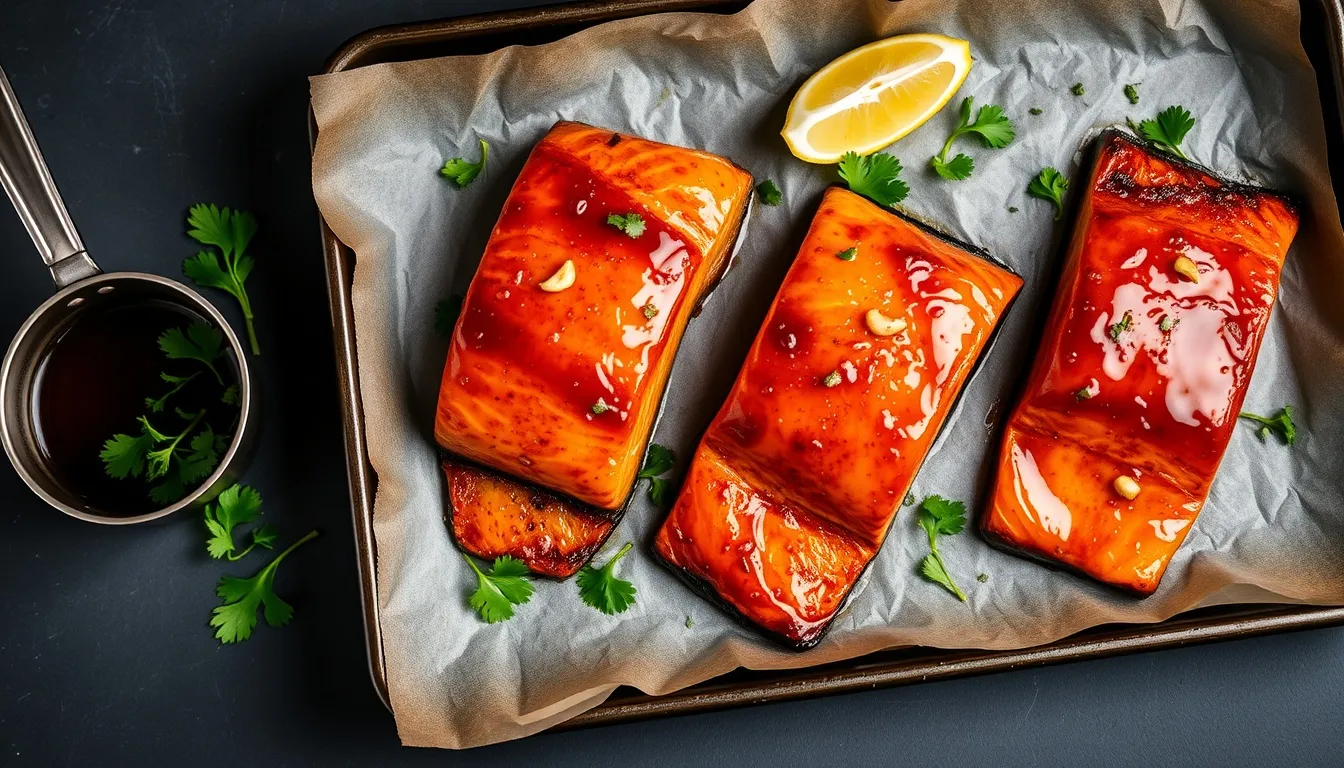
Serving the finished dish
Illustration of the finished dish. Optional garnishes and serving additions may be shown; the recipe card gives the measured base quantities.
Storage and reheating
Refrigerate cooked leftovers promptly in shallow covered containers. The government storage chart gives short refrigerator windows; use leftovers promptly and reheat them to 165°F (74°C), as listed in the temperature chart.
Keep clean serving sauce separate from brushes or utensils that have touched raw meat or seafood. Changes in portion size and thickness also change reheating time.
USDA ingredient-input nutrition estimate
The estimate uses the named raw Atlantic farmed salmon record and 680 g edible flesh without skin or bone. Another species or a skin-on portion has a different composition. All glaze and oil are counted; no fish-fat or sauce-retention factor is invented.
USDA input edible weights divided by yield; no cooking-loss or discarded-food adjustment assumed.
These are calculated ingredient estimates rather than laboratory values or evidence of recipe testing. Added sides and flavor variations need their own ingredients; the precision of the displayed number does not make every serving identical.
- USDA FoodData Central 175167
- USDA FoodData Central 169640
- USDA FoodData Central 174277
- USDA FoodData Central 169230
- USDA FoodData Central 171413
- USDA FoodData Central 173430
- USDA FoodData Central 167747
- USDA FoodData Central 170931
Cooking endpoint reference
The government fish temperature guidance uses 145°F in the center. The glaze can brown while the fish still needs cooking.