Honey or Maple Syrup: The Quick Choice
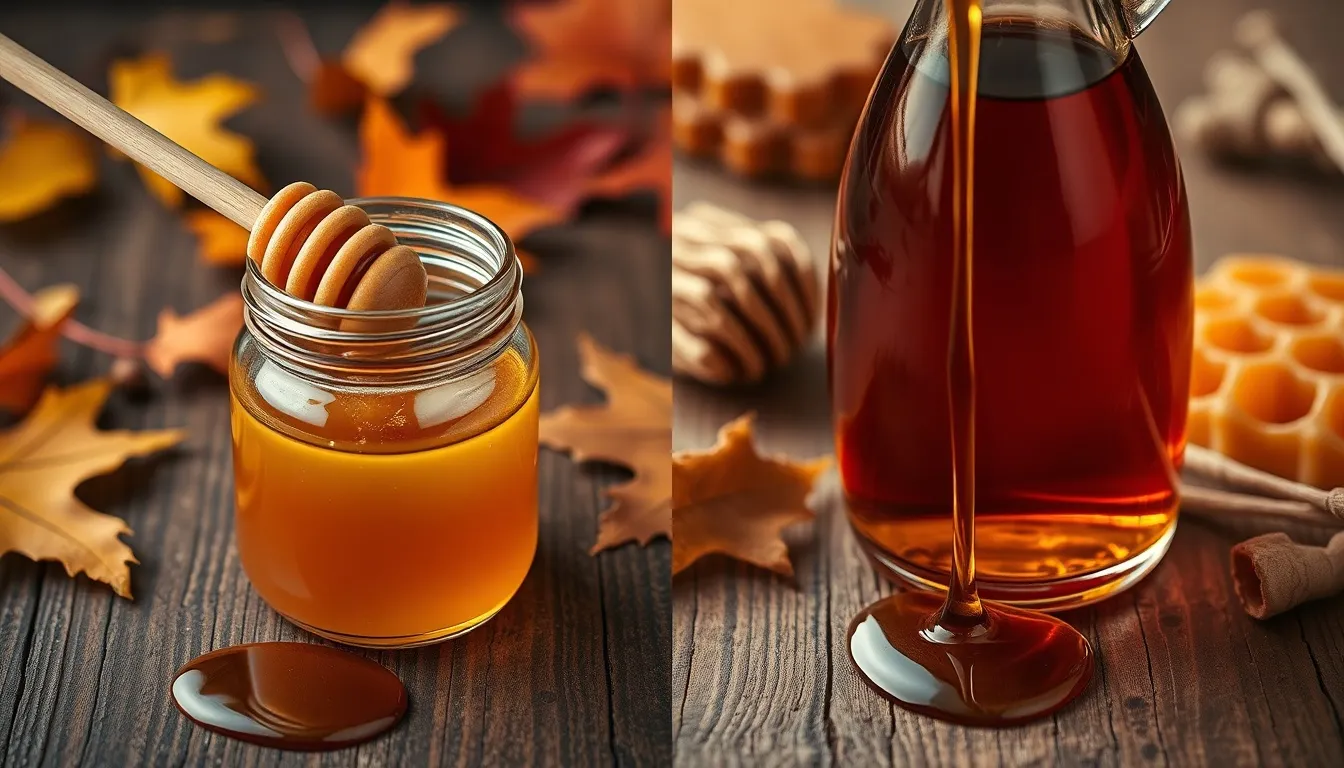
Pure maple syrup has fewer calories and less sugar than honey: one USDA tablespoon holds 52 kcal and 12.1 g of total sugars, against 64 kcal and 17.2 g for honey. Choose honey for its floral and varietal flavors, maple syrup for maple flavor or a vegan option. Neither is a universally healthier sweetener; both contribute added sugars.
For a simple honey-for-maple substitution, equal volume is a practical starting point. A spoonful stirred into yogurt is more forgiving than a cake or candy recipe, where the sweetener helps determine the texture.
- Everyday topping: choose the flavor you want on pancakes, oatmeal, or yogurt, then measure the amount you use.
- Vegan cooking: choose pure maple syrup; honey is produced by bees.
- Baking: use a recipe developed for the sweetener you have when the result needs to be predictable.
Nutrition Compared: One Tablespoon of Each
These are equal-volume servings with slightly different weights: 1 tablespoon of honey weighs 21 g in the USDA record, while 1 tablespoon of maple syrup weighs 20 g. They are not equal-weight portions or a claim of equal sweetness.
The figures below are rounded from the generic USDA FoodData Central records for honey and maple syrup. These SR Legacy records were published in 2019; they describe reference foods, not a recent test of every brand.
- Calories: honey 64 kcal; maple syrup 52 kcal.
- Total carbohydrate: honey 17.3 g; maple syrup 13.4 g.
- Total sugars: honey 17.2 g; maple syrup 12.1 g.
- Manganese: honey 0.017 mg; maple syrup 0.582 mg.
- Riboflavin (vitamin B2): honey 0.008 mg; maple syrup 0.254 mg.
Pro Tip
For these reference servings, 13.4 g is maple syrup's total carbohydrate, not its total sugars. Compare your own jars using the same serving size and their Nutrition Facts panels.
Honey (1 tbsp = 21 g)Maple syrup (1 tbsp = 20 g)
Per tablespoon, maple syrup has 12 fewer kcal and 5.1 g less total sugars than honey, and more manganese and riboflavin. Both count as added sugars; choose either for flavor, not for these minerals.
The same numbers as a table
| Per tablespoon | Honey (21 g) | Maple syrup (20 g) |
|---|---|---|
| Calories (kcal) | 64 | 52 |
| Total carbohydrate (g) | 17.3 | 13.4 |
| Total sugars (g) | 17.2 | 12.1 |
| Manganese (mg) | 0.017 | 0.582 |
| Riboflavin, vitamin B2 (mg) | 0.008 | 0.254 |
Source: USDA FoodData Central, SR Legacy (published April 2019), Honey (FDC 169640) and Syrups, maple (FDC 169661). Per-100 g values scaled to each record's tablespoon weight and rounded. Reference foods, not a test of any brand.
Get the Honey Buyer's Cheat Sheet (free PDF)
16 varieties on one page — color, flavor, best use and what a fair price looks like — from the 268 honeys we track.
What the Numbers Mean for Your Choice
At the same tablespoon measure, maple syrup supplies less sugar and fewer calories in these records. Pouring a larger portion can erase that difference: 2 tablespoons of maple syrup hold 24.2 g of total sugars and 104 kcal, more than the 17.2 g and 64 kcal in 1 tablespoon of honey. Compare the amount you actually add to a drink or recipe, rather than treating either sweetener as a free pour.
The calculator below compares your own pours, from 1 teaspoon up to 1 cup (16 tablespoons). It also runs on our sweetener comparison chart beside other sweeteners.
Maple syrup contains more manganese and riboflavin in the reference comparison. Honey's mineral content is lower, but those differences do not establish a general health winner. We recommend choosing these foods for sweetness and flavor, rather than adding them to obtain vitamins, minerals, or laboratory antioxidant benefits.
Both contribute added sugars to your diet, even when the jar contains only honey or maple syrup. The FDA explains the special label presentation for single-ingredient sweeteners: an added-sugars declaration does not mean another sugar was mixed into the product.
For diabetes meal planning, the American Diabetes Association advises checking serving size and total carbohydrate. Follow your existing care plan; a honey variety or maple grade does not replace that information. Our honey carbohydrate and label guide explains how those label terms fit together.
Compare your pour: honey vs maple syrup
Pick how much of each you actually use. The numbers scale the USDA tablespoon values (21 g of honey, 20 g of maple syrup); 1 tsp is a third of a tablespoon and ¼ cup counts as 4 tablespoons.
| Per pour | Honey1 tbsp | Maple syrup2 tbsp | Differencemaple − honey |
|---|---|---|---|
| Weight | 21 g | 40 g | +19 g |
| Calories | 64 kcal | 104 kcal | +40 kcal |
| Total carbohydrate | 17.3 g | 26.8 g | +9.5 g |
| Total sugars | 17.2 g | 24.2 g | +7.0 g |
With 1 tbsp of honey and 2 tbsp of maple syrup, the maple syrup has 7.0 g more total sugars and 40 more kcal.
Maple syrup reaches the total sugars of 1 tbsp of honey at about 1.4 tbsp.
Source: USDA FoodData Central SR Legacy records for honey (FDC 169640) and maple syrup (FDC 169661). Reference foods, not your jar's label; both sweeteners count as added sugars. This compares amounts and does not suggest how much to use.
Flavor, Maple Grades, and Dietary Preference
Honey varies with its floral source. For a milder starting point, try clover honey; for a stronger flavor, consider buckwheat honey. University of Missouri Extension specifically describes buckwheat honey as darker and stronger than clover. Taste a small amount before committing a distinctive honey to a whole batch.
Pure maple syrup is concentrated maple sap. Its grade gives you a useful flavor cue. The USDA Grade A standard pairs each color class with a taste description:
- Golden Color, Delicate Taste: choose when you want a lighter maple presence.
- Amber Color, Rich Taste: choose when you want an evident maple flavor.
- Dark Color, Robust Taste: choose when maple needs to stand out in the dish.
- Very Dark Color, Strong Taste: choose when you want the strongest of these grade descriptions.
Pro Tip
For a vegan sweetener, choose pure maple syrup. The Vegan Society excludes honey from its definition of veganism and lists maple syrup as an alternative. Check the ingredients if you are buying a flavored syrup or blend.
Which Works Better in Your Recipe?
Use flavor and the role of the sweetener to narrow the choice. These are culinary starting points, not claims that one sweetener produces a better result in every recipe.
UW–Madison Extension's maple cooking guidance suggests milder maple for dishes where sweetness matters more than a strong maple taste, and darker maple with roasted or charred foods.
- Pancakes and waffles: use maple syrup for a maple topping, or honey when you want the honey itself to be the main flavor. Start with a measured drizzle.
- Plain yogurt and oatmeal: either works. A mild honey or Golden maple lets fruit and other toppings remain prominent; a stronger honey or darker maple makes the sweetener more noticeable.
- Tea, coffee, and dressings: start with a small measured portion, stir thoroughly, and taste before adding more. A strongly flavored honey can change the drink or dressing substantially.
- Roasted vegetables and glazes: Dark maple is an option when you want a robust maple note. Choose honey when its particular flavor suits the other ingredients, and follow the cooking method in the recipe.
- Cakes, cookies, candy, and preserves: use a recipe written for your sweetener. Moisture, texture, setting, and storage requirements can make a casual swap unreliable.
How to Substitute Honey for Maple Syrup
Clemson Extension's All About Honey guide, hosted by UC Davis, allows honey to replace maple syrup in equal measure. Treat that as a volume starting point for simple uses, with a change in flavor and consistency, rather than a promise of identical results.
For a concrete recipe that offers either ingredient, University of Maine Extension's Cinnamon Yogurt Dip calls for 1 tablespoon of maple syrup or honey. Follow that recipe when you want to try the same measured amount in a stirred yogurt dish.
- 1 tablespoon maple syrup: start with 1 tablespoon honey.
- 2 tablespoons maple syrup: start with 2 tablespoons honey.
- 1/4 cup maple syrup: start with 1/4 cup honey, or 4 tablespoons.
- 1 cup maple syrup: equal measure means 1 cup honey. For baking or another recipe with a set texture, check a recipe developed for honey before making the full swap.
Pro Tip
Measuring the honey you plan to use? Convert cups, tablespoons, or teaspoons to grams with the honey weight–volume converter. It measures your honey portion; it does not calculate a tested maple-syrup recipe substitution.
Baking Adjustments Need the Recipe
There is no single oven-temperature or liquid adjustment that works for every honey–maple swap. Colorado State Extension's substitution guide explains that replacements can change taste, moisture, texture, weight, and sweetening power. Clemson likewise recommends recipes developed for honey when baking with it.
Instructions for replacing granulated sugar solve a different problem: a liquid sweetener is taking the place of a dry ingredient. Do not carry those reduced-liquid or oven-temperature rules over automatically when exchanging honey and maple syrup, which are both liquid sweeteners.
If maple flavor is central to the recipe, honey will make a different dish even if the amount works. For a special-occasion cake, a candy that must set, or a preserve intended for storage, choose a suitable tested formula rather than experimenting with the full batch.
Storage and the Infant Honey Rule
Honey: keep pure honey tightly closed in a dry place at room temperature, as described by Penn State Extension. Crystallization is natural and does not by itself mean the honey has spoiled.
Maple syrup: refrigerate after opening. University of Maine Extension advises discarding syrup that develops mold. Once either sweetener is mixed into a dish, follow that dish's storage instructions.
Do not give honey to a child younger than 12 months, including mixed into food or drink, because of infant botulism. The CDC also advises avoiding added sugars for infants and young children, so maple syrup is not a recommended baby-food substitute.