Can Honey Really Help Hair Grow?
If you search "honey for hair growth," you'll find thousands of articles promising miracle results. The reality is more nuanced — but there is genuine science behind why honey can support healthier hair growth conditions, even if it won't turn thin hair thick overnight.
Hair growth depends on follicle health, scalp circulation, adequate nutrition, and the absence of inflammatory conditions that damage follicles. Honey addresses several of these factors through its anti-inflammatory, antimicrobial, and antioxidant properties. Let's look at what the research actually shows.
What Science Says About Honey and Hair Growth
No large-scale clinical trial has directly tested whether applying honey to the scalp accelerates hair growth rate in healthy individuals. That's an important caveat. However, multiple studies demonstrate that honey improves the scalp conditions that are necessary for optimal hair growth.
A landmark 2001 study in the *European Journal of Medical Research* found that applying a mixture of 90% raw honey diluted with warm water to the scalp every other day significantly reduced scaling, itching, and hair loss associated with seborrheic dermatitis and dandruff. Patients who had been losing hair due to scalp inflammation saw hair loss stop within two weeks, with some reporting visible regrowth at the four-week mark.
A 2014 study in the *Journal of Cosmetic Dermatology* investigated honey's effects on hair fiber properties and found that honey solutions improved hair strand flexibility, reduced breakage, and enhanced moisture retention — all factors that allow hair to reach greater length by reducing mid-shaft breaks.
Research on honey's wound healing properties (documented in a 2015 Cochrane systematic review of 3,011 participants) demonstrates that honey accelerates tissue repair and cell regeneration. While these studies focused on skin wounds, the underlying mechanisms — growth factor stimulation, angiogenesis, and collagen synthesis — are the same processes involved in follicle cycling and hair regeneration.
Get the Honey Buyer's Cheat Sheet (free PDF)
16 varieties on one page — color, flavor, best use and what a fair price looks like — from the 268 honeys we track.
5 Ways Honey Supports Hair Growth
Understanding the specific mechanisms helps you decide whether honey might help your particular hair concern.
- **Scalp inflammation reduction** — Chronic scalp inflammation (from dermatitis, psoriasis, folliculitis, or product buildup) is a major cause of hair thinning. Honey's anti-inflammatory polyphenols (chrysin, pinocembrin, quercetin) inhibit the NF-κB pathway, reducing the inflammatory cytokines (TNF-α, IL-1β, IL-6) that damage hair follicles and push them prematurely into the telogen (resting) phase.
- **Antimicrobial scalp cleansing** — Bacterial and fungal overgrowth on the scalp (particularly *Malassezia* yeast in dandruff and seborrheic dermatitis) disrupts the follicular environment. Honey's hydrogen peroxide generation, low pH (3.2-4.5), and methylglyoxal (in manuka honey) inhibit these organisms without stripping beneficial microflora, unlike harsh antifungal shampoos.
- **Deep moisturization preventing breakage** — Hair appears to "grow" faster when it stops breaking. Honey is a natural humectant that draws moisture into the hair cortex, reducing the brittleness and split ends that cause mid-shaft breakage. This doesn't accelerate the growth rate at the follicle, but it means more of each strand reaches full length.
- **Antioxidant protection for follicles** — Hair follicle stem cells are vulnerable to oxidative stress from UV exposure, pollution, and metabolic byproducts. Honey's 30+ polyphenols neutralize reactive oxygen species (ROS) that can trigger premature catagen (regression phase) entry. Dark honeys like buckwheat honey ($15-25, ORAC 16,000+) contain 3-9x more antioxidants than lighter varieties like clover or acacia.
- **Nutritional support for keratin synthesis** — Honey provides trace minerals essential for hair protein synthesis: zinc (critical for keratin structural integrity), copper (melanin production and collagen cross-linking), and iron (oxygen delivery to follicle dermal papilla cells). While amounts per serving are modest, consistent intake contributes to the mineral pool that supports hair health from the inside.
The Gut-Hair Connection
One of the most promising mechanisms linking honey to hair health operates indirectly through the gut microbiome. Research published in *Cell Reports* (2019) demonstrated that the gut microbiome directly influences hair follicle cycling through immune signaling and nutrient synthesis.
Honey's prebiotic oligosaccharides (fructo-oligosaccharides and galacto-oligosaccharides) selectively feed beneficial *Bifidobacterium* and *Lactobacillus* species. These bacteria synthesize biotin (vitamin B7) — the most well-established nutrient for hair growth. They also produce short-chain fatty acids (SCFAs) like butyrate that reduce systemic inflammation, including the low-grade inflammation that accelerates androgenetic alopecia.
A 2021 study in *Experimental Dermatology* showed that gut dysbiosis (microbial imbalance) was significantly associated with alopecia areata, with reduced *Bifidobacterium* populations being a consistent finding. By supporting these populations through prebiotic intake, honey may help maintain the gut-hair axis that influences follicle health.
Pro Tip
This comparison does not establish a recommended daily honey serving. Use the daily added-sugar guide to count honey with other added or free sugars.
Best Honey Types for Hair Growth
Not all honeys offer the same benefits for hair. Choose based on your specific concern.
- **Manuka honey (UMF 10+, $35-60+)** — Best for scalp infections, dandruff, seborrheic dermatitis, and folliculitis. Methylglyoxal provides non-peroxide antimicrobial activity that targets *Malassezia* and *Staphylococcus* without irritation. The gold standard for therapeutic scalp application.
- **Buckwheat honey ($15-25)** — Highest antioxidant content (ORAC 16,000+ — 3-9x more than lighter varieties), making it ideal for protecting follicles from oxidative stress. Best for those concerned about age-related thinning or environmental damage.
- **Raw wildflower honey ($10-18)** — Good all-purpose option with diverse polyphenol spectrum from multiple nectar sources. Wildflower's broad antimicrobial and anti-inflammatory profile makes it suitable for general scalp health maintenance.
- **Thyme honey ($18-30)** — Contains retained thymol and carvacrol compounds with potent antifungal activity. Particularly effective for dandruff and seborrheic dermatitis where fungal overgrowth is the primary concern.
- **Acacia honey ($12-20)** — Best for sensitive scalps. Acacia's mild flavor, lowest GI (~32), and lower acidity make it less likely to cause irritation while still providing humectant moisturizing benefits.
DIY Honey Hair Growth Treatments
These treatments address the scalp conditions that support optimal hair growth. Apply to clean, damp hair for best absorption.
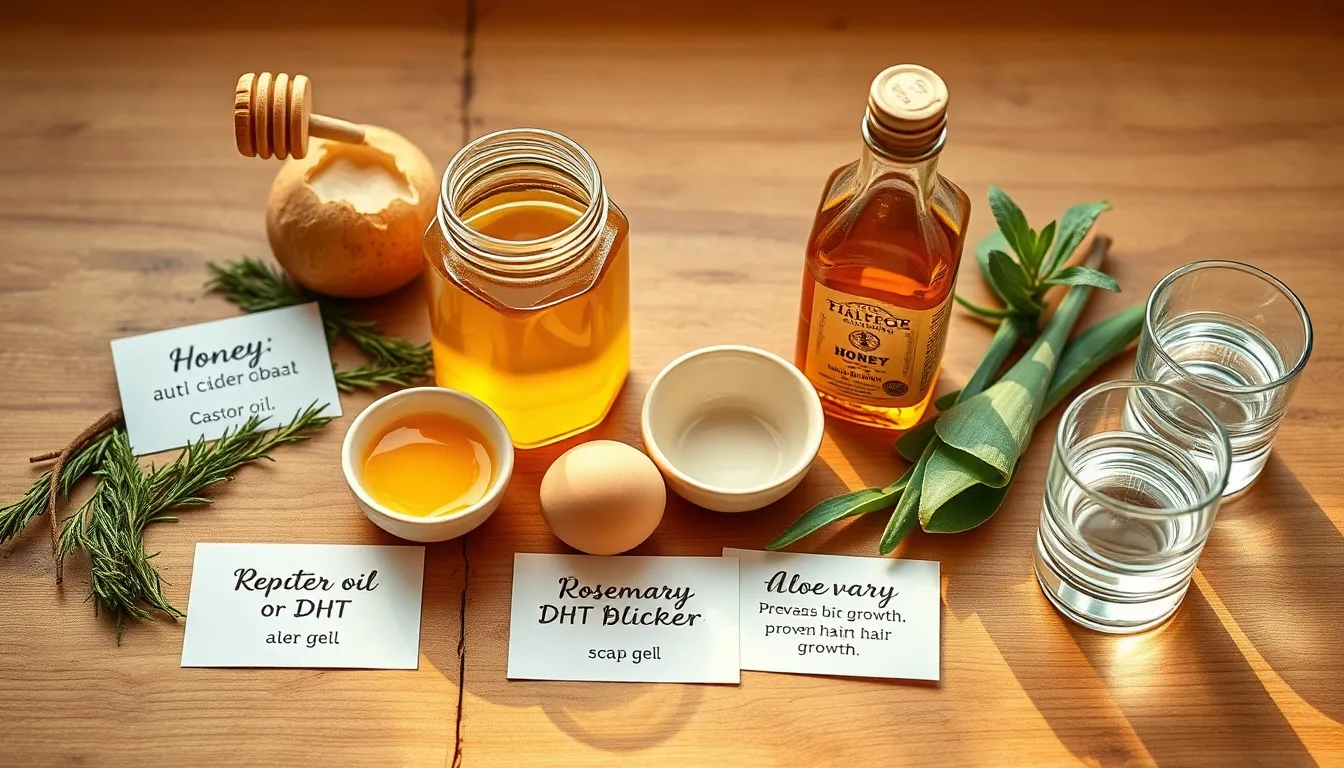
- **Scalp growth stimulation mask** — Mix 3 tablespoons raw honey with 1 tablespoon castor oil (rich in ricinoleic acid that may improve scalp circulation) and 3 drops rosemary essential oil (2015 *SKINmed* study showed rosemary comparable to 2% minoxidil for androgenetic alopecia over 6 months). Massage into scalp for 5 minutes, leave 30-45 minutes under a shower cap, rinse thoroughly.
- **Anti-dandruff growth treatment** — this describes the method from a small clinical trial (diluted raw honey massaged into the scalp and left on for a few hours) that studied honey for hair loss linked to seborrheic dermatitis. Seborrheic dermatitis is a medical condition — a dermatologist can advise on whether and how to try this rather than self-directing a multi-week schedule.
- **Deep conditioning length-retention mask** — Mix 2 tablespoons honey with 1 mashed avocado (oleic acid penetrates the hair shaft) and 1 tablespoon coconut oil (reduces protein loss by 39% per 2003 *Journal of Cosmetic Science*). Apply root to tip, focusing on ends. Leave 20-30 minutes, then shampoo out.
- **Egg protein repair mask** — Whisk 2 tablespoons honey with 1 egg yolk (lecithin, biotin, fatty acids). Apply to damp hair, leave 20 minutes, rinse with cool water (hot water cooks the egg). This repairs protein damage that causes breakage, helping existing hair reach greater length.
- **Aloe vera scalp soother** — Blend 2 tablespoons honey with 2 tablespoons fresh aloe vera gel. The proteolytic enzymes in aloe dissolve dead skin cells blocking follicles while honey provides antimicrobial protection. Apply to scalp, leave 30 minutes, rinse.
Pro Tip
For any honey scalp treatment, warm the honey slightly (not above 40°C/104°F to preserve enzymes) for easier application and better scalp penetration. Heating honey above this threshold degrades beneficial enzymes but doesn't make it toxic.
Honey for Specific Hair Loss Conditions
Different types of hair loss have different causes. Here's how honey relates to each.
- **Androgenetic alopecia (male/female pattern)** — Honey cannot block DHT (the hormone responsible for follicle miniaturization). However, its anti-inflammatory and antioxidant properties may slow the inflammatory component of pattern hair loss. Consider it a supportive measure alongside proven treatments (minoxidil, finasteride), not a replacement.
- **Telogen effluvium (stress shedding)** — Triggered by stress, illness, nutritional deficiency, or hormonal changes. Honey can address several contributing factors: stress/cortisol reduction via gut-brain axis support, nutritional trace mineral supplementation, anti-inflammatory effects that may help follicles re-enter anagen (growth phase) faster.
- **Seborrheic dermatitis hair loss** — This is where honey has the strongest evidence. The 2001 EJMR study demonstrated clear improvement in hair retention and regrowth when seborrheic dermatitis was controlled with topical honey application.
- **Alopecia areata** — An autoimmune condition where the immune system attacks follicles. Propolis (another bee product) has more direct evidence here — a 2015 study in the *Journal of Dermatological Treatment* showed propolis outperformed placebo for alopecia areata regrowth. Honey's immunomodulatory properties may complement propolis, but direct evidence is limited.
- **Traction alopecia** — Caused by tight hairstyles pulling on follicles. The primary intervention is stopping the traction; honey's general anti-inflammatory and wound-healing properties are sometimes used to support scalp comfort once the mechanical stress is removed, though this is not a treatment for the underlying cause.
- **Postpartum hair loss** — Normal shedding of hair retained during pregnancy. Honey won't prevent this hormonally-driven shedding, but its nutritional support (especially gut-mediated biotin synthesis) and stress-reducing properties may help hair regrow faster once the shedding phase ends.
Internal vs Topical: Which Works Better?
Both approaches have merit, and they work through different pathways.
Topical honey application directly addresses scalp conditions — inflammation, microbial overgrowth, dryness, follicle blockage — that prevent hair from growing normally. It works from the outside in, creating a healthier follicular environment.
Eating honey works from the inside out through three pathways: prebiotic support for gut bacteria that synthesize biotin and reduce systemic inflammation, trace mineral delivery for keratin synthesis, and anti-inflammatory polyphenol absorption that dampens the chronic low-grade inflammation linked to progressive hair thinning.
This comparison does not establish a recommended daily honey serving. Use the daily added-sugar guide to count honey with other added or free sugars.
Honey vs Other Natural Hair Growth Remedies
How does honey compare to other popular natural approaches?
- **Rosemary oil** — Stronger direct evidence for hair growth (2015 *SKINmed* RCT showed comparable results to 2% minoxidil over 6 months). Works by improving scalp circulation and inhibiting 5-alpha-reductase. Pair with honey for complementary benefits — rosemary stimulates growth while honey provides the scalp environment for it.
- **Castor oil** — Popular folk remedy but limited clinical evidence for hair growth specifically. Contains ricinoleic acid that may improve circulation. Often combined with honey in hair masks for dual moisturizing and growth-supporting effects.
- **Biotin supplements** — Effective only for those with actual biotin deficiency (uncommon in healthy diets). Honey's prebiotic support for biotin-synthesizing gut bacteria provides a more natural pathway to adequate biotin levels.
- **Minoxidil** — FDA-approved, strongest evidence for hair regrowth (both male and female pattern hair loss). Honey cannot replace minoxidil for pattern baldness. However, honey can complement minoxidil by reducing the scalp irritation and dryness that are common side effects.
- **Coconut oil** — Proven to reduce protein loss from hair (2003 *Journal of Cosmetic Science*), preventing breakage. Does not stimulate growth at the follicle. Excellent in combination with honey for length retention.
- **Onion juice** — A 2002 *Journal of Dermatology* study showed 87% regrowth in alopecia areata patients using onion juice. The sulfur compounds may improve follicle nutrition. Honey and onion juice can be combined, with honey masking the strong odor.
Common Myths About Honey and Hair Growth
Setting realistic expectations prevents disappointment.
- **Myth: Honey makes hair grow faster** — Hair growth rate is primarily determined by genetics and hormones (about 0.5 inches/month average). Honey doesn't accelerate this rate. It helps hair reach greater length by reducing breakage and creating healthier scalp conditions for normal growth to occur unimpeded.
- **Myth: Any honey works the same** — Processing matters significantly. Commercial "pure honey" that's been ultra-filtered and pasteurized has lost most of the enzymes, hydrogen peroxide activity, and pollen that contribute to scalp health benefits. Raw honey retains these active compounds.
- **Myth: More honey = faster results** — Excessive honey on the scalp can be counterproductive — it's difficult to rinse out completely, and residue attracts dirt and can clog follicles. Thin, diluted applications (matching the 90% honey + 10% water protocol from the EJMR study) work better than thick globs.
- **Myth: Honey can reverse baldness** — If follicles have been permanently miniaturized (as in advanced androgenetic alopecia) or destroyed (scarring alopecia), no topical treatment including honey can regrow hair. Honey helps most when hair loss is driven by inflammation, infection, or environmental damage.
- **Myth: Honey lightens hair significantly** — Honey contains small amounts of hydrogen peroxide, but not enough to noticeably lighten hair color. The "honey lightening" effect requires extended sun exposure and produces subtle results at most.
Safety and Practical Tips
Honey is generally very safe for hair and scalp use, but a few precautions will ensure the best results.
- **Skin sensitivity** — Topical honey can cause irritation or allergy; stop after a reaction and seek medical advice for swelling or breathing symptoms.
- **Rinse thoroughly** — Honey residue left on the scalp attracts dirt and can cause buildup. Use warm (not hot) water and gentle shampoo to fully remove. Two rinses may be needed.
- **Frequency** — For scalp treatments: many use these a couple of times a week for maintenance. Dandruff and dermatitis are medical conditions best evaluated by a dermatologist rather than managed on a fixed DIY schedule. For deep conditioning masks: once weekly to avoid protein overload.
- **Temperature** — Warm honey slightly for easier application, but stay below 40°C/104°F to preserve enzymatic activity. Never microwave — this creates hot spots that can burn the scalp.
- **Expectations** — Evidence does not establish honey as a hair-growth treatment or predict a response timeline; unexplained hair loss warrants clinical evaluation.
Pro Tip
If you're experiencing sudden or severe hair loss, see a dermatologist before relying on honey or any natural remedy. Hair loss can signal thyroid disorders, iron deficiency anemia, hormonal imbalances, or autoimmune conditions that require medical treatment.