
Can Honey Actually Help Stomach Ulcers?
Stomach ulcers — also called peptic ulcers or gastric ulcers — affect an estimated 4 million people in the United States each year. These painful sores develop when the protective mucus lining of the stomach or duodenum breaks down, allowing digestive acid to erode the tissue beneath.
Honey has been used as a traditional remedy for stomach complaints for thousands of years, from ancient Egyptian medicine to Ayurvedic practice. But modern research has revealed specific mechanisms that explain why this folk remedy may have genuine scientific merit — while also highlighting important limitations.
This guide examines what the research actually shows about honey for stomach ulcers, which types work best, and when honey is a helpful complement versus when you need medical treatment. For broader digestive context, see our guide on honey and gut health.
Understanding Stomach Ulcers
Most stomach ulcers have two primary causes:
**Helicobacter pylori infection** — This bacterium colonizes the stomach lining and triggers chronic inflammation that weakens the mucus barrier. *H. pylori* is present in roughly 50% of the world's population but only causes ulcers in about 10-20% of carriers. It's responsible for approximately 60-70% of gastric ulcers and 70-80% of duodenal ulcers.
**NSAID use** — Non-steroidal anti-inflammatory drugs (ibuprofen, aspirin, naproxen) inhibit COX-1 enzymes that produce protective prostaglandins in the stomach lining. Regular NSAID use accounts for most remaining ulcers.
**Other contributing factors** — Excessive alcohol, smoking, severe physiological stress (burns, major surgery, critical illness), and rare conditions like Zollinger-Ellison syndrome can also cause or worsen ulcers.
Symptoms include burning stomach pain (especially between meals or at night), bloating, heartburn, nausea, and in severe cases, vomiting blood or dark tarry stools — which require immediate medical attention.
Get the Honey Buyer's Cheat Sheet (free PDF)
16 varieties on one page — color, flavor, best use and what a fair price looks like — from the 268 honeys we track.
Honey's Anti-H. pylori Activity
The most clinically relevant aspect of honey for ulcers is its activity against *H. pylori*, the bacterium behind most ulcers:
**In vitro evidence** — A 2006 study in the *Sultan Qaboos University Medical Journal* demonstrated that honey inhibited *H. pylori* growth at concentrations as low as 20% (v/v). The antibacterial effect was dose-dependent: higher concentrations produced stronger inhibition. Multiple studies have confirmed that manuka honey ($35-60+ for UMF 10+) shows particularly potent anti-*H. pylori* activity due to its methylglyoxal (MGO) content working alongside hydrogen peroxide.
**Clinical evidence** — A 2015 study in the *Journal of Antimicrobial Chemotherapy* found that manuka honey (UMF 10+) inhibited *H. pylori* strains including antibiotic-resistant isolates. A 2013 *Oxidative Medicine and Cellular Longevity* study found that Tualang honey protected gastric mucosa in animal models and reduced ulcer index scores.
**Biofilm disruption** — *H. pylori* forms protective biofilms that make it resistant to antibiotics. A 2014 study in *FEMS Immunology & Medical Microbiology* showed that manuka honey disrupted bacterial biofilms — a property that could theoretically enhance the effectiveness of standard triple therapy (antibiotics + PPI). This biofilm-disrupting ability has been documented for honey against multiple bacterial species.
**Important context** — While honey shows clear anti-*H. pylori* activity in laboratory settings, no clinical trial has demonstrated that honey alone can eradicate an *H. pylori* infection in humans. Eradication typically requires combination antibiotic therapy. Honey's role is best understood as a potential complement to medical treatment, not a replacement.
Pro Tip
If you've been diagnosed with an H. pylori infection, complete your prescribed antibiotic course. Honey may be a useful supportive measure, but it cannot replace antimicrobial therapy for eradication.
Gastroprotective Mechanisms: 5 Ways Honey Protects the Stomach
Beyond its antimicrobial effects, honey protects the stomach lining through multiple mechanisms:
- **Mucosal coating and barrier support** — Honey's viscous consistency provides a physical coating over the stomach lining, similar to the protective effect of sucralfate. A 2006 study in *BMC Complementary and Alternative Medicine* found that honey's viscosity and osmolarity contribute to its gastroprotective effects by creating a temporary barrier between stomach acid and damaged tissue.
- **Anti-inflammatory NF-κB inhibition** — Honey's polyphenols (chrysin, pinocembrin, quercetin, caffeic acid) inhibit the NF-κB inflammatory pathway — the same cascade that drives ulcer-related tissue damage. The 2022 *Nutrition Reviews* meta-analysis of 18 RCTs confirmed honey's systemic anti-inflammatory effects. Reducing local inflammation in the gastric mucosa allows damaged tissue to heal. See more in our honey for inflammation guide.
- **Antioxidant protection against oxidative stress** — Ulcers generate significant reactive oxygen species (ROS) that worsen tissue damage. Honey's 30+ polyphenols scavenge free radicals and activate the Nrf2 antioxidant pathway, reducing oxidative damage to gastric epithelial cells. Dark honeys like buckwheat provide 3-9x more antioxidants than lighter varieties.
- **Prostaglandin stimulation** — Animal studies have shown that honey can stimulate prostaglandin E2 (PGE2) production in gastric tissue. PGE2 is a key protective factor that increases mucus secretion, bicarbonate output, and mucosal blood flow — essentially the opposite of what NSAIDs do when they cause ulcers.
- **Prebiotic gut microbiome support** — Honey's fructo-oligosaccharides (FOS) and galacto-oligosaccharides (GOS) selectively feed beneficial bacteria like *Bifidobacterium* and *Lactobacillus*, which produce short-chain fatty acids (SCFAs) including butyrate. Butyrate strengthens the gut epithelial barrier and has anti-inflammatory effects on the entire GI tract.
Clinical Evidence for Honey and Ulcers
Several studies have investigated honey's effects on gastric ulcers and related conditions:
**Animal model evidence** — A 2012 study in *Oxidative Medicine and Cellular Longevity* found that Tualang honey (1 g/kg) significantly reduced gastric ulcer formation in rats exposed to ethanol and indomethacin, with ulcer index reductions of 56-68%. The protective effect was comparable to omeprazole (a standard PPI). A 2008 study in the *Journal of ApiProduct and ApiMedical Science* found similar gastroprotective effects with manuka honey.
**Gastritis evidence** — A 2013 study in *Oxidative Medicine and Cellular Longevity* demonstrated that honey reduced histological markers of gastric inflammation, including edema, inflammatory cell infiltration, and epithelial damage. While this studied gastritis rather than established ulcers, chronic gastritis is a precursor to ulcer formation.
**Honey as adjunctive therapy** — A 2016 pilot study published in *Evidence-Based Complementary and Alternative Medicine* explored honey alongside standard triple therapy for *H. pylori*. While the study was small and preliminary, the combination group showed numerically higher eradication rates, suggesting potential synergy that warrants larger trials.
**NSAID-induced damage** — Honey's prostaglandin-stimulating and anti-inflammatory effects are particularly relevant for NSAID-induced ulcers, where prostaglandin suppression is the primary damage mechanism. While no human trial has specifically tested honey for NSAID gastroprotection, the mechanistic rationale is strong.
**Honest assessment** — The evidence for honey and stomach ulcers is promising but still primarily preclinical. We have strong in vitro anti-*H. pylori* data, convincing animal model gastroprotection data, and solid mechanistic rationale — but large randomized controlled trials in human ulcer patients are still needed. This is a case where the basic science is ahead of the clinical evidence.
Best Honey Types for Stomach Ulcers
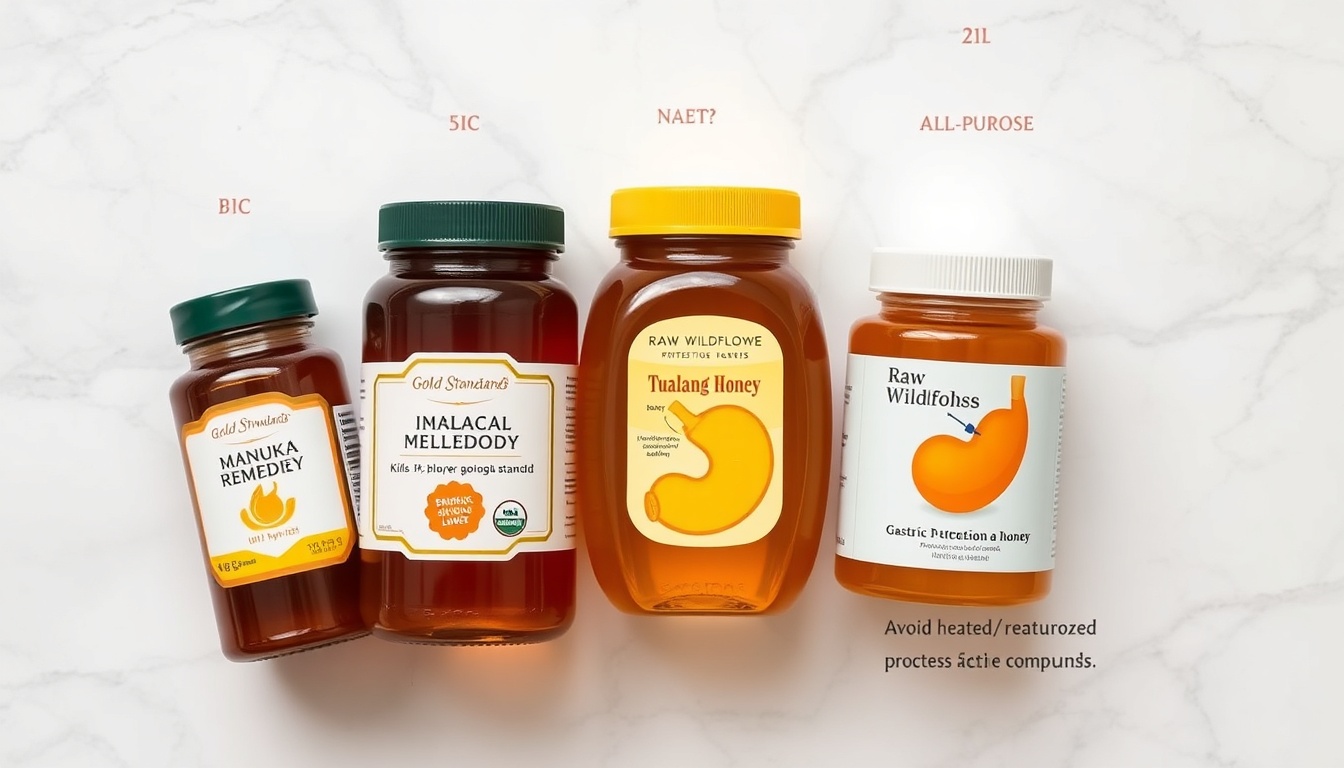
Not all honeys are equally effective for gastric protection. The best choices based on available evidence:
**Manuka honey (UMF 10-15+, $35-60+)** — The most studied honey for gastrointestinal applications. Methylglyoxal (MGO) provides non-peroxide antibacterial activity that remains effective in the stomach's acidic environment (unlike H₂O₂-dependent honeys). Best for *H. pylori*-related ulcers. A UMF 10+ (MGO 263+) is the minimum therapeutic grade. For more on grading, see our manuka honey grading guide.
**Buckwheat honey** ($15-25, ORAC 16,000+ μmol TE/100g) — Contains 3-9x more antioxidants than lighter varieties (2004 *Journal of Agricultural and Food Chemistry*), providing superior free radical scavenging in ulcer-damaged tissue. Its robust polyphenol profile includes quercetin and rutin, both with documented gastroprotective effects.
**Tualang honey** — Specifically studied for gastroprotection in multiple animal models. Contains a diverse polyphenol profile with strong anti-inflammatory activity. Less commercially available outside Southeast Asia.
**Thyme honey** ($15-25) — Thymol and carvacrol compounds provide additional antimicrobial activity. Thyme honey ranked among the highest for antibacterial potency in a 2018 *Journal of Agricultural and Food Chemistry* comparison of 48 European honeys. Learn more about thyme honey benefits.
**Sidr (jujube) honey** — Traditional Middle Eastern use for stomach complaints. In vitro antimicrobial potency comparable to UMF 15+ manuka in some studies (2013 *Journal of Medicinal Food*). See our sidr honey guide.
Pro Tip
For stomach ulcers specifically, choose raw, unprocessed honey. Pasteurization destroys glucose oxidase (which generates hydrogen peroxide) and reduces polyphenol content — both important for gastroprotection. Budget-conscious options include wildflower honey ($10-18) or clover honey ($8-15) — both provide gastroprotective compounds when raw. See raw vs regular honey for details.
How to Take Honey for Stomach Ulcers
Honey is not established as ulcer care; suspected ulcers or H. pylori need testing and clinician-directed treatment.
Treatment boundary — Honey is not established as ulcer treatment and must not replace testing or clinician-directed care.
Evidence does not support repeating honey through the day for ulcer symptoms.
**Method** — Take honey directly from the spoon, or dissolve in lukewarm water (below 40°C/104°F to preserve enzymes). Do not mix with hot liquids, which can degrade active enzymes. For more on temperature effects, see is heated honey toxic.
**Duration** — Traditional use and animal-study timelines do not establish a human ulcer treatment; ulcers and possible H. pylori infection require clinician-directed care.
**Combination approaches** — Honey combined with other evidence-supported compounds may enhance effects: honey + ginger (prokinetic + anti-inflammatory), honey + turmeric (dual NF-κB suppression), or honey + aloe vera (mucosal healing synergy).
This section does not establish a universal or medical honey dose for this purpose. Use the daily added-sugar guide to count honey with other added or free sugars.
Honey for Specific Ulcer-Related Conditions
Different ulcer-related conditions may benefit from different approaches:
**Gastric (stomach) ulcers** — Manuka honey's non-peroxide antibacterial activity is most relevant here, as it remains active in the stomach's acidic pH (1.5-3.5). This is not a substitute for testing and clinician-directed treatment of a diagnosed ulcer.
**Duodenal ulcers** — These form in the first section of the small intestine and classically cause nocturnal pain. Diagnosed duodenal ulcers need clinician-directed treatment rather than a honey timing routine.
**Gastritis (stomach inflammation)** — Pre-ulcer inflammation responds well to honey's anti-inflammatory polyphenols. A 2013 study showed honey reduced multiple histological markers of gastric inflammation. Regular honey intake may help prevent gastritis from progressing to ulceration.
**GERD and acid reflux** — Related but distinct from ulcers. Honey's viscosity and anti-inflammatory properties can soothe the esophageal lining. See our dedicated guide on honey for acid reflux.
**Post-antibiotic recovery** — After completing *H. pylori* eradication therapy (which typically includes two antibiotics), honey's prebiotic properties can help restore beneficial gut bacteria disrupted by antibiotics. This is one of honey's strongest evidence-based applications. See honey and gut health for details.
When to See a Doctor: Red Flags
Honey is a complementary approach, not a treatment for serious conditions. Seek immediate medical attention if you experience:
- **Vomiting blood** (bright red or coffee-ground appearance) — indicates active bleeding ulcer
- **Black, tarry stools (melena)** — indicates GI bleeding
- **Sudden, severe abdominal pain** — may indicate ulcer perforation, a surgical emergency
- **Unintentional weight loss** — may indicate complications or other conditions
- **Persistent symptoms despite treatment** — ulcers that don't respond to 8+ weeks of PPI therapy need further investigation
- **Difficulty swallowing or persistent vomiting** — may indicate stricture formation or gastric outlet obstruction
- **Symptoms over age 55 with no prior history** — new-onset dyspepsia in older adults warrants endoscopy to rule out malignancy
Honey vs Conventional Ulcer Treatments
Understanding how honey compares to established medical treatments:
**Proton pump inhibitors (PPIs)** — Omeprazole, esomeprazole, pantoprazole. These are the gold standard for ulcer healing, reducing gastric acid by 90-97%. Honey cannot match this acid suppression. However, PPIs have known side effects with long-term use (bone fracture risk, magnesium depletion, increased infection risk, B12 deficiency), making honey an attractive complementary option for long-term management.
**H2 receptor antagonists** — Ranitidine (withdrawn), famotidine, cimetidine. Reduce acid by ~70%. Honey cannot replace these for acute ulcer treatment but may help reduce reliance on acid suppressants for chronic management.
**Triple therapy for H. pylori** — PPI + clarithromycin + amoxicillin (or metronidazole) for 14 days. This is the only proven way to eradicate *H. pylori*. Honey cannot replace antibiotic therapy. Emerging research suggests honey may enhance eradication rates when used alongside standard therapy.
**Sucralfate** — Creates a protective barrier over ulcer craters. Honey provides a similar (though less targeted) coating effect through its viscosity, plus additional anti-inflammatory and antimicrobial benefits.
**Probiotics** — Used adjunctively to improve *H. pylori* eradication rates and reduce antibiotic side effects. Honey's prebiotic properties complement probiotics by feeding the beneficial bacteria they introduce. A honey and yogurt combination provides both prebiotic and probiotic support.
**Bottom line** — Honey is best positioned as a complementary measure alongside medical treatment, not as an alternative. For mild gastritis or ulcer prevention, honey may be sufficient. For diagnosed ulcers, especially *H. pylori*-positive, medical treatment is essential.
Safety and Precautions
Honey is generally safe for ulcer patients, but keep these considerations in mind:
- Carbohydrate note — Honey contributes carbohydrate and added sugar. An ulcer diagnosis or treatment plan is a separate medical question and should not be based on a honey serving.
- **Calorie awareness** — 4 tablespoons of honey per day adds ~256 calories. Factor this into your daily intake, especially if managing weight. See honey for weight loss.
- **Infant safety** — Never give honey to children under 12 months due to infant botulism risk. See when can babies have honey.
- **FODMAP sensitivity** — Honey is high in fructose and classified as high-FODMAP above 7g (about 1 tsp). If you have IBS or fructose malabsorption, start with small amounts. See honey for bloating.
- **Drug interactions** — Honey may theoretically enhance the effects of anticoagulants (warfarin) and blood sugar medications. Consult your doctor if taking these. See side effects of honey.
- **Quality matters** — Use raw, unprocessed honey for gastroprotective benefits. Pasteurized honey has reduced enzyme activity and lower polyphenol content. See how to tell if honey is real.
The Bottom Line
Honey has genuine scientific potential for stomach ulcer management. Its anti-*H. pylori* activity, gastroprotective mechanisms (mucosal coating, anti-inflammatory polyphenols, prostaglandin stimulation, antioxidant protection, prebiotic support), and long history of traditional use all support its role as a complementary measure.
The evidence is strongest for: (1) gastroprotection and ulcer prevention, (2) anti-inflammatory support for gastritis, (3) prebiotic recovery after antibiotic therapy, and (4) in vitro anti-*H. pylori* activity. The evidence is weakest for: using honey as a standalone ulcer treatment in humans.
For the best results, choose raw manuka honey (UMF 10+, $35-60+) or buckwheat honey ($15-25, ORAC 16,000+). Always complete prescribed medical treatments for diagnosed ulcers, and consider honey as part of a comprehensive approach to gastric health that includes diet, stress management, and appropriate medical care.